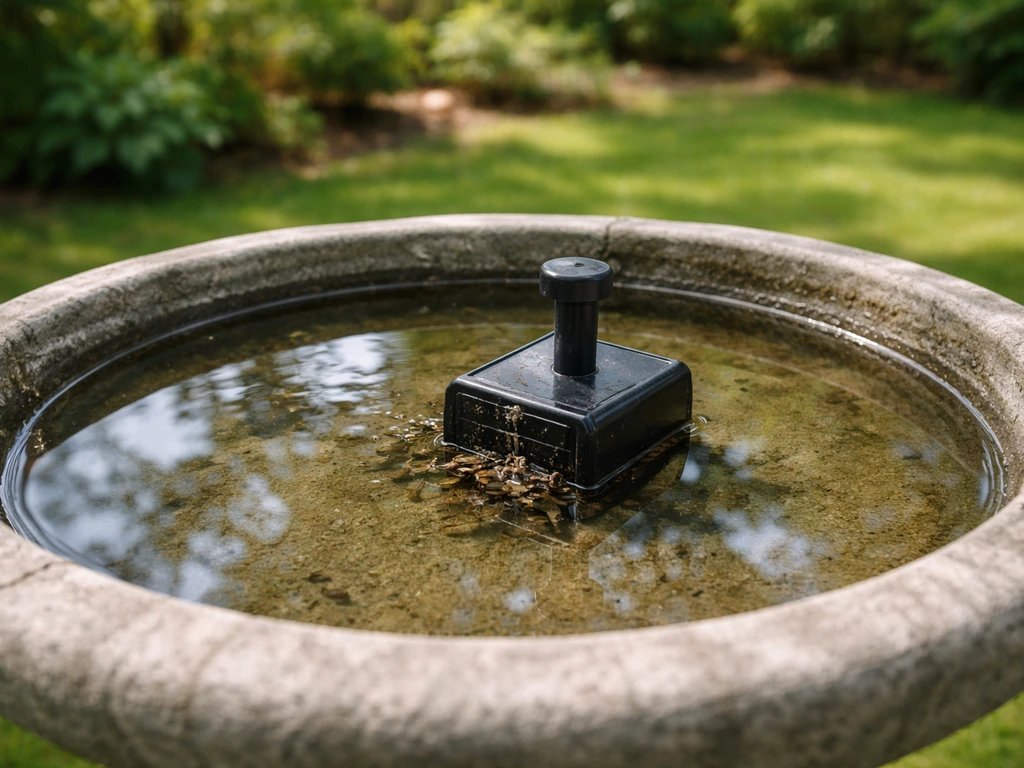
Most bird baths go unvisited not because birds dislike your yard, but because the bath is in the wrong spot. Prey selection and predation behavior of free-roaming domestic cats in an urban ecosystem, peer-reviewed study notes that Domestic cats and other terrestrial predators concentrate predation where prey, cover, or supplementary food are available; meta-analyses and field studies show cat predation rates and likelihood of attacks increase where feeders/water are placed adjacent to dense cover or forest edges and where supplemental food is abundant Prey selection and predation behavior of free-roaming domestic cats in an urban ecosystem — peer-reviewed study. Placing a bath in full sun against the fence, directly under a feeder, or three feet from a window creates a cascade of problems: rapid algae growth, mosquito breeding within days, stressed or injured birds, and pumps that burn out far ahead of schedule. Fix the location and most of those problems either disappear or become dramatically easier to manage.
Bird Bath Placement Mistakes: Fixes for Safer, Cleaner Baths

Why placement is the foundation of everything
I've helped a lot of backyard birders troubleshoot baths that 'just don't work,' and the root cause is almost always location, not the bath itself. Placement controls bird attraction (do birds feel safe enough to land and linger?), safety (are they exposed to cats, hawks, or glass?), cleanliness (how fast does the water turn green?), function (does the pump stay submerged and running?), and longevity (does frost crack the basin, does sun bleach and warp the material?). Get placement right and everything downstream, cleaning schedules, pump maintenance, winter prep, becomes easier. Get it wrong and you're fighting those problems continuously regardless of how nice the bath is.
Every placement mistake worth knowing about
These are the errors I see most often, roughly ordered from most to least obvious. Some feel like common sense in hindsight, but they catch experienced birders too.
- Placing the bath in full, all-day direct sun — accelerates algae, heats water uncomfortably, and degrades plastic and metal baths quickly
- Placing the bath in full shade all day — water stays colder and less inviting, and shade-loving mosquitoes thrive in still, shaded water
- Setting the bath directly under a feeder — seed hulls, droppings, and debris fall straight into the water, dramatically shortening the time before the water becomes foul
- Sitting the bath too close to dense low shrubs or ground cover — increases ambush risk from cats and snakes, reducing how often birds will visit
- Placing the bath too far from any cover — birds won't use a bath that requires a long, exposed flight to reach safety; they need escape cover within a few seconds' flight
- Positioning the bath within 3–30 ft of a window — the most dangerous sweet spot for window collisions; birds flushed from the bath can strike glass before they reach full speed awareness
- Setting the bath directly beneath or adjacent to a tall exposed perch (fence post, power line pole, tall dead snag) — gives raptors a ready hunting position overlooking the bath
- Placing the bath on an uneven or unstable surface — the basin tilts, water pools to one side and leaves shallow areas that splash out, and pedestal baths are prone to tipping
- Putting a solar-powered bath or pump fountain in a shaded location — the panel underperforms, the pump cycles on and off repeatedly, shortening motor life and leaving water stagnant for stretches of the day
- Burying or hiding the power cord and pump intake under debris, gravel, or close to a wall — restricts intake flow, clogs faster, and makes routine maintenance a chore you'll skip
- Positioning the bath where it drains toward a foundation, deck, or path — overflow and splash create slip hazards and water damage
- Placing a metal or dark ceramic bath in full sun in warm climates — the basin can reach temperatures that scald birds' feet and make water undrinkable
- Locating the bath somewhere difficult for you to reach — if you can't comfortably refill and scrub it every two to three days, it won't stay clean
- Setting up a ground-level bath in a yard with known cat activity and no cat deterrent — ground-level baths are great for robins and doves but require specific cat-proofing
- Placing a heated bath's cord in a route that collects snow or standing water — creates an electrical hazard and, in some climates, a code violation
How the wrong location makes seasonal problems worse
Placement mistakes don't cause the same damage year-round. Each season amplifies different errors, which is why a bath that seems fine in October can be a disaster by July.
| Placement mistake | Spring consequence | Summer consequence | Autumn consequence | Winter consequence |
|---|---|---|---|---|
| Full sun all day | Faster algae onset as temps rise | Water too hot to drink; algae blooms within 24 hrs; basin degradation | Continued algae; debris in warm spells | Freeze-thaw cycles crack concrete and ceramic faster in exposed spots |
| Under a feeder | Seed debris and bird droppings spike; algae and bacteria explode | Mosquito larvae in nutrient-rich water within days (CDC: standing water breeds larvae in days) | Heavy leaf + seed load; thick biofilm | Debris freeze-locks into basin, cracking it |
| Too far from cover | Lower bird visit frequency as nesting season increases predator vigilance | Birds avoid exposed baths during peak heat when they're already stressed | Fewer migrants stop; raptor season increases risk | Exposed position accelerates freeze |
| 3–30 ft from a window | Increased flush-strikes as territorial birds are active and alert | Same risk, compounded by fast-moving juveniles | Migratory birds unfamiliar with your yard hit glass | Less foliage buffer increases glass reflectivity |
| Shaded spot for solar pump | Panel output low in weak spring sun; pump stalls | Partial shade from summer foliage stops pump repeatedly — motor wears faster | Falling leaves block panel | Panel iced over; pump should be removed anyway |
| Unstable or unlevel base | Frost heave shifts the base; bath tips in first thaw | Tipped basin leaves low-water zones; pump runs dry | Falling leaves shift lightweight stands | Ice expansion on a tilted basin cracks it unevenly |
Fix each mistake directly: the relocation and retrofit map
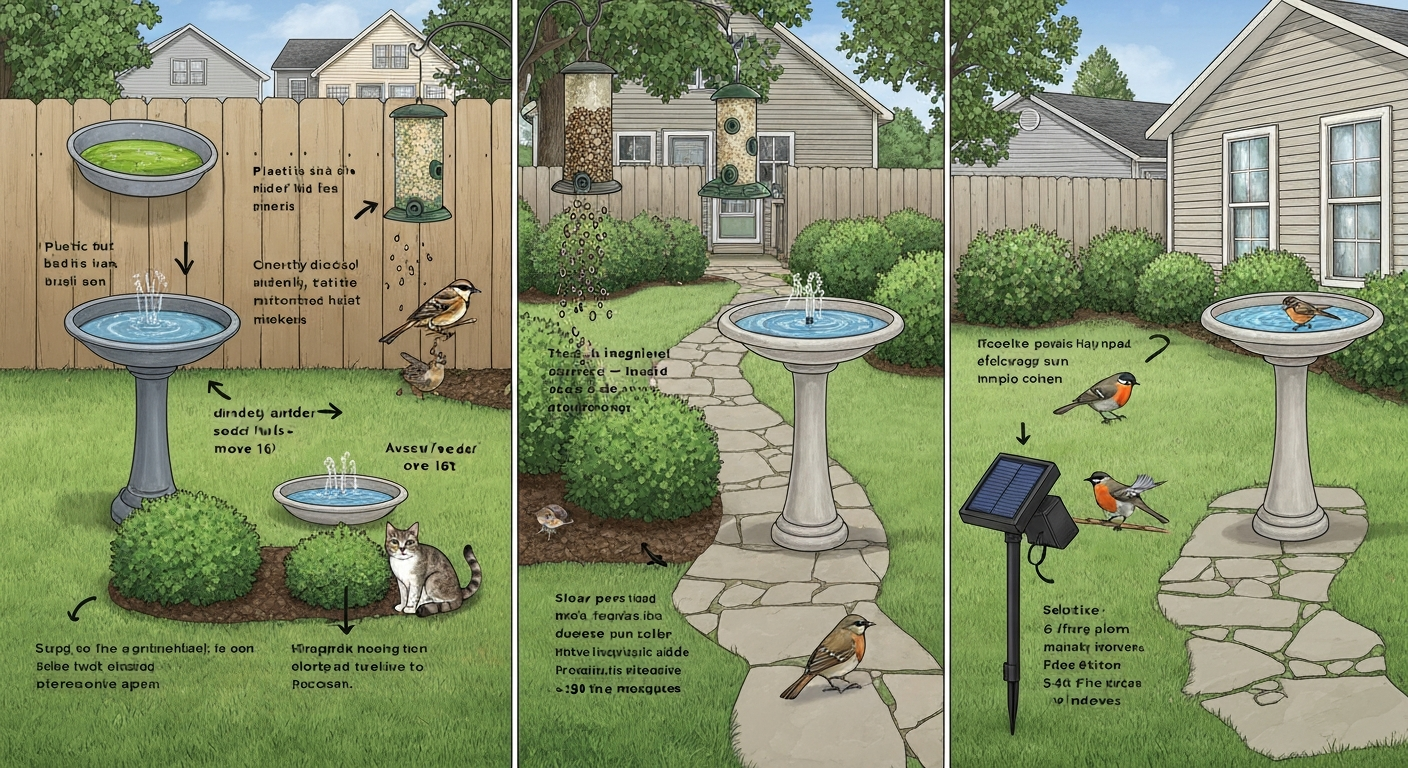
For every placement error there's a direct fix. Some require moving the bath, others just need a simple add-on. Here's how I approach each one.
Too much sun or too much shade
The sweet spot is dappled or morning sun with afternoon shade, especially in climates that get above 85°F regularly. Morning sun warms the water slightly (birds prefer it to icy-cold water) and the afternoon shade slows algae and keeps water temperatures reasonable. If you can't relocate, a market umbrella, shade sail, or well-placed shrub can create the right microclimate. For metal baths specifically, afternoon shade is non-negotiable in hot climates because the basin surface can reach temperatures that burn feet and superheat the water.
Directly under the feeder
Move the bath at least 10 feet away from any seed feeder, ideally on the opposite side of the yard. The bath should still be visible from the feeder area so birds discover it, but debris and droppings shouldn't be landing in it. If space is genuinely limited, place the bath upwind of the feeder and elevate it at least 12 inches higher than the feeder hang point so seed hulls clear it.
Wrong distance to cover
Research into bird foraging behavior consistently shows birds treat bathing sites just like feeding sites: they want quick access to escape cover, but not so close that the cover itself hides predators. Behavioral decisions made under the risk of predation: a review and prospectus, Lima & Dill (1990) documents that foraging animals perceive predation risk as increasing with distance from protective cover, and therefore prefer feeding and bathing sites within a short, quick-retreat distance of cover Behavioral decisions made under the risk of predation: a review and prospectus — Lima & Dill (1990). A buffer of roughly 3 to 15 feet from a shrub or small tree works well for most yards. You want a clear visual field around the bath so the bird can spot danger, with a dense shrub or tree canopy within a short, fast flight (a few wing beats, not a long glide). Placing the bath right inside a dense shrub is one of the most reliable ways to hand cats a meal.
Window collision distance
Both the Audubon Society and the American Bird Conservancy use a practical two-option rule: place the bath either within 3 feet (1 meter) of the window, so a flushed bird can't build enough speed to seriously injure itself, or at least 30 feet (about 10 meters) away, giving it room to redirect. The dangerous zone is everything in between, roughly 3 to 30 feet, where birds gain speed but can't correct course before hitting glass. If your yard doesn't allow 30 feet of clearance, move the bath as close to the window as practical and add window film or decals to break up the reflection. Distance alone isn't always enough on complex sightlines.
Raptor perch overlap
Walk your yard and look for tall exposed perches with a clear sightline over the bath: fence posts, power line poles, dead snags, or tall garden structures. If the bath is directly beneath or within the hunting radius of one of those, move the bath or use a baffle. A simple large-diameter squirrel baffle mounted on the pedestal pole won't stop a flying hawk, but repositioning the bath under partial tree cover breaks the clean sightline a raptor needs for a reliable strike.
Unstable or unlevel base
A level, stable base is underrated. An unlevel bath means water is constantly shallower on the high side, which causes the pump intake to gulp air, the fountain to run dry, and birds to splash the water out faster. Use a spirit level when setting up any pedestal bath. On grass, I drive a short ground stake or use a flagstone pad to prevent frost heave from shifting things over winter. For hanging baths, three-point suspension is far more stable than two-point.
Solar pump in shade
Solar floating pumps need direct, unobstructed sunlight to run consistently. Even partial shading from a nearby tree branch causes the pump to cycle on and off repeatedly, which is hard on the motor and leaves the water stagnant during the off periods. If the only good bird-bath location is partially shaded, use a wired electric pump with a long cord to a GFCI outlet rather than fighting a solar panel's intermittent output. If you're committed to solar, use a model with a separate panel on a stake that you can angle toward the sun independently of the bath position.
Drainage and overflow direction
Before you permanently install any bath, pour a bucket of water in it and watch where it goes when it overflows. You want overflow headed toward garden beds or lawn, not toward a foundation, deck, or walkway. A slight downhill grade away from structures is ideal. If you can't achieve that naturally, a simple gravel drainage apron around the base catches and disperses overflow cleanly.
Safety-specific placement errors: predators, glass, pets, and foot traffic
Cats and ground predators
Domestic cats and feral cats are the biggest ground-level threat to bathing birds. Studies show cat predation rates climb sharply when supplemental food or water is placed adjacent to dense low cover or along fence lines cats already patrol. The fix is threefold: elevate the bath on a pedestal at least 24 to 36 inches off the ground; keep a 3-foot clear zone of open ground around the base so a bird can see an approaching cat; and use a smooth pole or cone baffle if cats in your area are known climbers. Ground-level baths for robins and thrushes specifically should only go in a section of yard you can actively manage for cat access, ideally enclosed or in a fenced area the cat can't enter.
Window glass
The 3-feet-or-30-feet rule is the most actionable single piece of placement advice for safety. I'd add: even at under 3 feet, add window decals or tape strips spaced no more than 2 inches apart vertically and 4 inches apart horizontally on the glass surface, because small windows on complex house facades create confusing reflections the distance rule doesn't fully address.
Dogs and children
An active dog yard isn't compatible with a ground-level bird bath. Elevate the bath beyond a dog's reach (most medium-large breeds can reach 30 to 36 inches) or locate it in a fenced garden section. For yards with young children, avoid placing a bath where splash zones create a slip hazard on hard surfaces, and keep electrical cords for heated baths routed out of reach and protected with outdoor cord covers.
Human foot traffic
Birds need predictability. A bath placed on a frequently used path, near a gate that slams, or beside the air conditioning unit that cycles on loudly will see little use. Choose a spot with low-disturbance foot traffic and stable background noise. You also need the bath accessible enough that you can reach it without disturbing it every time you refill or clean it. Tucking it behind an awkward corner to hide it from guests usually means it gets neglected.
Setup and site requirements done right
Height, stability, and access
Most birding resources recommend pedestal bath heights of 24 to 36 inches for a good balance between accessibility to a wide range of species and protection from ground predators. For a complete checklist of site, height, and safety specs, see bird bath requirements. For a step-by-step bird bath setup guide covering height, base, and material choices, see my detailed setup recommendations. Hummingbirds, which forage and bathe at mid-canopy level, prefer a hanging or elevated bath at 4 to 6 feet, ideally near the nectar feeders they already visit. Ground-feeding species like mourning doves, robins, and sparrows will happily use a shallow dish set on a stump or flat stone at ground level or just a few inches above it, but only in a yard where ground predator pressure is low or well-managed.
Distance to cover and perches
The ideal setup has the bath visible from a nearby perch (a branch, fence top, or garden stake) where birds can land and assess the bath before committing to descend. Place a simple wooden dowel or thin branch stake within 3 feet of the bath if there's no natural perch nearby. Then make sure the nearest dense cover (a shrub, hedge, or tree canopy) is between 3 and 15 feet away, offering a clear flight path with no ground-level obstructions between the bath and the cover.
Sightlines and visibility
Birds choosing a bathing site behave similarly to how they choose a feeding site: they want to see threats coming from multiple directions. A bath hemmed in on three sides by walls or dense plantings gives birds limited escape vectors and reduces their comfort. Open sightlines from at least two or three directions are important. At the same time, a completely open, unobstructed location in the middle of a lawn is too exposed and will be largely ignored, especially by smaller species.
Species-specific placement
| Bird type | Preferred bath height | Cover distance | Other placement notes |
|---|---|---|---|
| Hummingbirds | 4–6 ft (hanging or elevated) | Close canopy or vine cover nearby | Place near nectar feeder; they often bathe in misters or dripper-style baths rather than standing water |
| Robins, thrushes, doves | Ground level to 6 inches | 3–10 ft to dense shrub | Need low cat-pressure area; shallow water (1–1.5 in) essential |
| Crows, jays | Any height; prefer open sight lines | 10–20 ft to cover acceptable | Prefer larger, deeper baths; less bothered by exposed positions |
| Sparrows, finches, warblers | 18–36 in pedestal | 3–10 ft to cover | Shy; value consistent, low-disturbance position |
| Woodpeckers, nuthatches | Any; often use birdbath near tree | Right next to tree trunk or large branch | Drippers or moving water particularly attractive |
How placement affects your cleaning workload
Here's the honest truth: a bath in the wrong spot can triple your cleaning frequency. For more on diagnosing and fixing bird bath problems, see the dedicated troubleshooting guide. Placement under a deciduous tree in summer means leaves, caterpillar frass, and bird droppings are constantly entering the water. Organic debris adds phosphorus and nitrogen, which are exactly the nutrients that fuel algae and biofilm. A bath in full sun with those nutrient inputs can turn green within 24 hours in July. Move the same bath to a spot with afternoon shade, away from the tree canopy and the feeder, and the same water can stay clean for three to four days before scrubbing is needed.
Standard guidance from extension programs and conservation groups is to rinse and refill bird baths every two to three days in warm weather, with a thorough scrub and diluted bleach rinse (roughly 1 part bleach to 9 parts water, then rinse completely) about once a week. In winter or cool weather with low bird traffic, once a week for the full clean is often enough. For step-by-step bird bath care instructions on cleaning, winter prep, and pump maintenance, see the dedicated care guide. A bath in a high-debris location may need daily rinsing, which quickly becomes unsustainable. Choosing the right location is genuinely the most effective 'cleaning hack' I know.
Algae and the sun-shade balance
Algae growth in small water features is driven by three things: warm temperature, sunlight, and nutrients. Placement controls two of those three directly. A bath with afternoon shade in a debris-free zone will need bleach treatment maybe once every two weeks in summer. The same bath in full sun under an oak tree might need it every three days. Increasing water circulation (even a simple drip or wiggler) reduces hydraulic residence time, which also inhibits algae and makes the bath more attractive to birds simultaneously.
Operational problems that start with placement
Mosquito breeding
A bird bath in full sun, directly under a tree, in a stagnant corner of the yard is essentially a mosquito nursery. The CDC notes that standing water in small containers produces mosquito larvae within days, which means a bath you skip refilling for a week in July is actively contributing to your local mosquito population. For more on preventing disease and hazards around water features, see our bird bath safety guidance. The placement fixes (away from debris sources, with some sun but not all-day, with a drip or circulating pump to keep water moving) address the root cause. If you're in a climate where keeping moving water isn't always possible, Bacillus thuringiensis israelensis (Bti) products, commonly sold as mosquito dunks or bits, are effective against larvae and considered essentially non-toxic to birds and mammals by the WHO. That said, Bti is a management tool for imperfect placement, not a substitute for fixing the placement itself.
Frozen water in winter
A bath in a fully exposed, north-facing location in a cold-climate yard will freeze faster and stay frozen longer than one in a more sheltered spot. Before buying a heated bath or a deicer, consider whether a simple relocation to a south-facing, wind-sheltered position (against a south wall, for example) reduces how often you need to run the heater. That said, in climates with sustained sub-freezing temperatures, a thermostatically controlled immersion heater or a purpose-built heated bath is the reliable solution. Place the power cord along a path that avoids water pooling and connect it to a GFCI outlet. Concrete baths in exposed positions are the most vulnerable to freeze-thaw cracking because concrete is porous; if you're in USDA zone 5 or colder, either bring the concrete bath in for winter or choose a freeze-resistant resin or plastic model for the exposed position.
Pump not working or failing early
The most common pump failures I've seen trace directly back to placement decisions. A solar pump in a shaded spot cycles on and off all day, burning out the motor in a fraction of its rated lifespan. A submersible pump placed near a leaf drop zone clogs its intake in days. A pump in a tilted bath runs dry on the shallow side. Manufacturer troubleshooting guides for virtually every pump model cite the same culprits: low water level, clogged intake, air lock, and freeze damage. Fix the placement first: level the bath, keep it away from heavy leaf drop, position the solar panel in full sun (using a separate-panel model if needed), and always pull and store the pump before the first hard freeze. If you're troubleshooting a pump, see the guide on bird bath pump not working for step‑by‑step checks and fixes. For wired electric pumps, route the cord away from water pooling paths and use waterproof cord covers.
Short pump life in hot, sunny positions
UV radiation and heat degrade plastic pump housings faster than most people expect. A small submersible pump in a dark-colored metal or ceramic bath in full summer sun can see water temperatures above 90°F, which strains the motor and accelerates seal degradation. Afternoon shade for the bath basin directly extends pump life, in addition to all the bird comfort and algae benefits.
Material and climate interactions with placement
Different bath materials respond to placement conditions differently. Knowing this helps you decide whether to move the bath or change the material.
| Material | Full sun risk | Cold climate risk | Best placement | Worst placement |
|---|---|---|---|---|
| Concrete | Algae growth; surface dries and cracks over seasons | Freeze-thaw cracking if water sits in pores | Dappled shade; sheltered from north wind in winter | Exposed full sun in summer; unsheltered in zone 5 and colder |
| Ceramic / glazed | Glaze helps reduce algae but basin heats | Glaze can crack in freeze-thaw; drain before first freeze | Morning sun, afternoon shade | Fully exposed cold-climate position |
| Metal (steel, copper) | Heats rapidly; scalds feet; water becomes very hot | Durable but can dent with ice expansion if left full | Afternoon shade essential in warm climates | Full sun in zones 7+ during summer |
| Resin / plastic | UV degrades material over years; water heats | Freeze-resistant; best material for year-round cold-climate use | Shade extends lifespan significantly | Full sun year-round shortens material life |
| Heated bath (electric) | Not typically a sun issue | Designed for cold; must be near GFCI outlet; cord routing critical | Sheltered south-facing position near outlet | Far from power; cord running through water pooling area |
Quick placement checklist: move, modify, or add hardware
Use this before you finalize any bird bath position. For more detailed setup and maintenance tips, see our comprehensive bird bath guide. It's also useful for diagnosing a bath that's already in place but underperforming. For more detailed bird bath tips consult the referenced guide.
- Is the bath within 3 to 30 feet of a window? If yes, move it outside that range or add window decals to the glass.
- Is it in full all-day sun? If yes, add afternoon shade via a tree, umbrella, or shade sail, or relocate.
- Is it directly under a feeder or a deciduous tree? Move it at least 10 feet away from debris sources.
- Is the nearest cover farther than 15 feet away, or is the bath sitting inside dense ground-level shrubs? Adjust position to 3–15 feet from a shrub or small tree with clear open ground around the bath.
- Is there an exposed perch (fence post, power line) with a clear sightline over the bath? Block the sightline with a baffle or relocate the bath out of the raptor hunting radius.
- Is the base level and stable? Check with a spirit level and add a flagstone pad or ground stake as needed.
- Is the solar panel getting direct, unobstructed sun? If not, switch to a separate-panel model or a wired pump.
- Is the bath accessible to you for refilling and scrubbing every 2–3 days? If not, move it or accept that it will be undercleaned.
- In cold climates: is the bath in an exposed position prone to fast freezing? Add a thermostatically controlled deicer or move to a south-facing sheltered spot.
- Does overflow drain away from structures and walkways? Adjust grade or add a gravel drainage apron.
When to move vs. when to modify
Moving the bath is the right call when the location is fundamentally wrong: it's in the dangerous window-collision zone, it's getting all-day direct sun with no fix available, or it's adjacent to ground-level predator cover you can't control. Modification is the right call when the location is mostly good but has one fixable problem: add a shade sail for afternoon sun, install window decals for a bath that's slightly too close to a window, add a baffle for a tilted base, or add a drip or wiggler to reduce mosquito risk. Don't overcomplicate it. Most bird bath problems respond to one or two targeted changes, not a complete yard redesign.
FAQ
What are the most common placement mistakes that reduce bird attraction or create safety risks?
Placing a bath too far from cover, too close to dense concealment, directly under trees or feeders, immediately beneath or within hunting/perch lines, too close or at risky distances from windows, on uneven/unstable bases, or in full, hot sun without shade. These errors either make birds feel exposed to predators, invite ambush predators (cats/snakes), increase debris and algal inputs, or raise window‑strike and overheating risks.
Why does distance to cover matter, and what is the right distance?
Birds balance thirst with predation risk: too far from cover they won't visit; too close (inside dense shrubs) increases ambush risk. Practical rule: place baths within a few metres of shelter but leave an open buffer of ~3–15 ft (1–5 m) so birds can see predators approach and have a quick escape route. Species that forage on the ground prefer lower and slightly more open sites.
How do windows cause problems and what are the placement solutions?
Windows cause collision risk because birds cannot perceive or misjudge reflections. Follow the '≤3 ft (1 m) or ≥30 ft (10 m)' practical rule: either place baths very close to windows (within ~1 m) or well away (>~10 m). Retrofit glass with decals/screens if you must place baths at intermediate distances.
How does placing a bath under trees or feeders hurt cleanliness and function?
Leaves, twigs, seeds, and droppings fall into the water, adding nutrients that accelerate algae and biofilm growth, and provide food for mosquito larvae. Increased debris clogs pumps and shortens cleaning intervals; in warm weather this can make water foul in days.
What are the mosquito and algae risks tied to placement and how to prevent them?
Warm, sunlit, nutrient‑rich, stagnant water breeds mosquitoes and algae quickly. Fixes: site baths with partial shade to reduce temperature and light, increase circulation (fountain/pump), clean/refill frequently (weekly or every 2–3 days in hot weather), remove leaf sources, use Bti larvicide per label if continuous water is needed, and add surface movement to discourage larvae.
How does pump and electrical placement interact with bird bath location and longevity?
Pumps must stay submerged at recommended depth and have unobstructed intakes. Locate baths so cords reach GFCI outlets without tripping hazards and protect cables from pets and weather. Avoid placing pumps where leaves accumulate; provide easy pump access for cleaning and winter removal. Solar pumps need consistent sun—avoid intermittent shade that causes repeated start/stop and premature wear.
Bird Bath Pump Not Working: Fix Flow Fast With Steps
Troubleshoot a bird bath pump not working fast: power, clogs, air lock, scale, placement, and safe reset or replacement