To attract hummingbirds to a bird bath, use a shallow basin with edges no deeper than 1 inch (2.5 cm), add a mister or dripper to create moving water, place it within 10 to 20 feet of nectar feeders and flowering plants, and change the water daily. Those four things do most of the work. Everything else, material choices, mounting height, heated options for winter, is just dialing in the details for your specific yard and climate.
How to Attract Hummingbirds to Bird Bath: Setup, Care & Mosquito Control

Marcus Henley
21 Jul 2026
Quick-start checklist: set up a hummingbird-friendly bird bath today
If you want to get something in the yard quickly and worry about optimizing later, run through this checklist. Each item directly addresses a reason hummingbirds skip a bath or leave and don't return.
- Choose a basin that is shallow: edges no deeper than 1 inch (2.5 cm) and center no deeper than 2 inches (5 cm). A simple terracotta saucer or a purpose-made hummingbird bath works well.
- Add movement: clip a small dripper or battery-powered water wiggler to the edge. If you have a hose nearby, a misting attachment is even better.
- Pick a location within 10 to 20 feet of your nectar feeder or a flowering plant hummingbirds are already visiting.
- Make sure there is a clear perch, a dead twig, a clothesline, a thin wire, within a few feet of the bath so birds have somewhere to preen after bathing.
- Keep open ground between the bath and dense shrubs to reduce ambush risk from cats and other predators.
- Fill with fresh, room-temperature water and change it daily (or every other day at minimum) during warm weather.
- Avoid soap, bleach, or chemical cleaners when hummingbirds are actively visiting; a stiff brush and a 9:1 water-to-white-vinegar rinse is enough for routine cleaning.
- If you have glazed ceramic or decorative tile, verify the glaze is modern and food-safe to avoid any risk of lead leaching into the water.
How and why hummingbirds use water: behavior that affects design choices
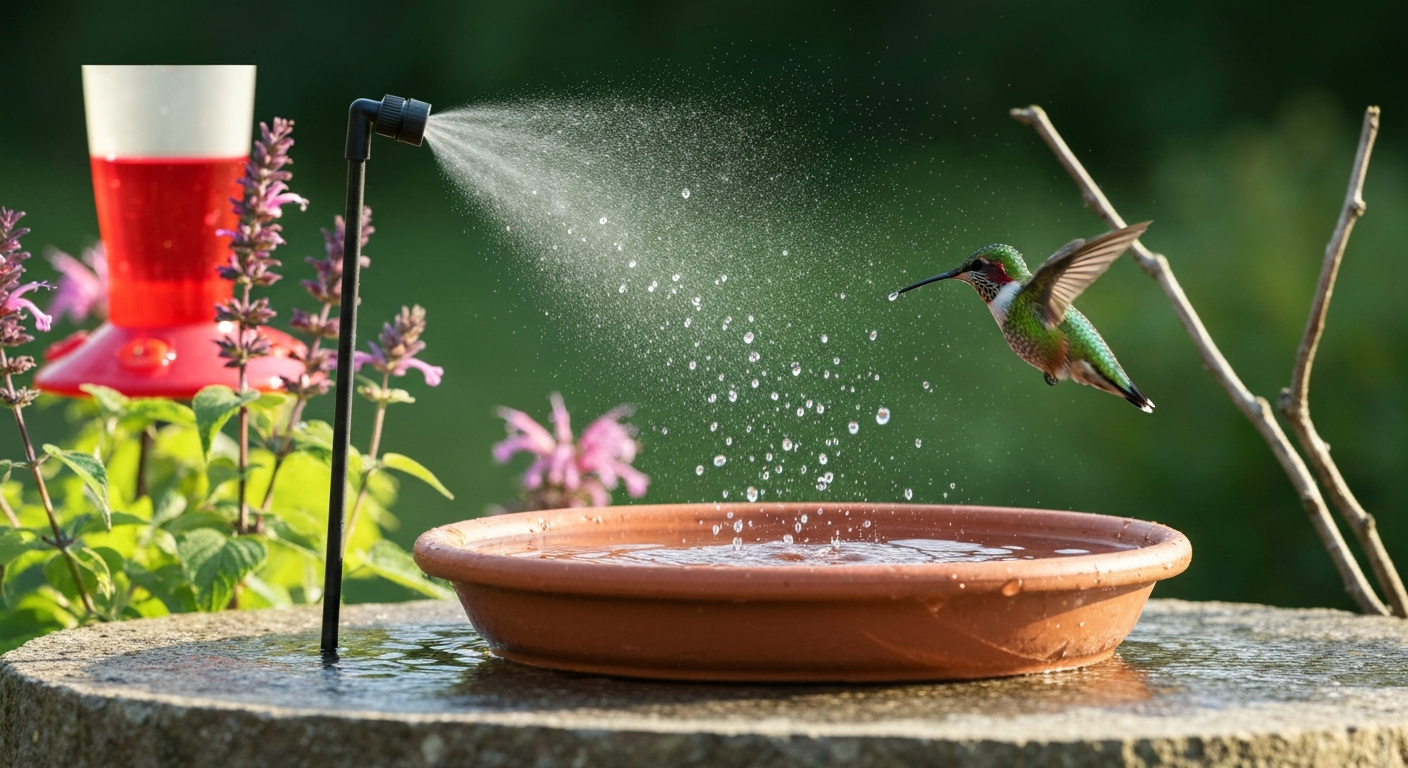
Hummingbirds interact with water differently than robins or sparrows, and understanding that changes what you buy and where you put it. They have two main bathing behaviors. The first is splash bathing in very shallow water, belly-dipping and shaking, similar to what other small birds do but even more sensitive to depth. The second is aerial bathing, where they fly repeatedly through fine mist or spray, hovering and darting. Documented observations of species like the Black-chinned Hummingbird show them using sprinklers and misters specifically for this aerial spray-bathing. They are not wading into a bowl; they are threading through droplets while flying.
This behavioral split explains why a standard pedestal bird bath, deep and still, often gets ignored by hummingbirds even when other species use it happily. The depth is wrong for belly-dipping and there is no mist for aerial bathing. It also explains why a mister attached to a shallow saucer, which seems like a simple or even improvised setup, consistently outperforms elaborate decorative baths. Hummingbirds are also attracted to the sound and sight of moving water, so even a slow drip over the edge of a basin will pull them in from further away than a still pool would.
There is also a cooling function to consider. On hot days, hummingbirds need to regulate body temperature, and a fine mist acts almost like air conditioning. In July and August, I see more activity at the mister than at the nectar feeder during peak afternoon heat. So water is not just hygiene for these birds; it is active thermoregulation, which means bath activity spikes on your hottest days.
Which bird bath types attract hummingbirds: materials, shapes, and finishes
Not every bath on the market is a good fit for hummingbirds. Here is how the main options stack up.
Terracotta and unglazed clay saucers
These are genuinely the best starting point. A basic 12- to 14-inch terracotta plant saucer costs a few dollars, has a naturally textured surface hummingbirds can grip, and is shallow by design. The slightly rough interior gives birds traction, which matters more than most people realize. Glazed ceramics can be slippery enough that small birds avoid them. Terracotta is easy to scrub and replace. The downside is it is porous and will stain or crack if left out through a freeze-thaw cycle. In cold climates, bring it in before first frost or expect to replace it each spring.
Glazed ceramic and decorative tile baths
A glazed ceramic bath can look beautiful and does hold water well, but check two things before buying: depth and surface texture. Many decorative baths are too deep for hummingbirds without modification (a flat stone placed in the center to raise the effective floor works fine). Also, older or imported ceramics with low-quality glazes can leach lead or other metals, especially if the glaze gets scratched or acidic water sits in it for extended periods. Stick with modern, clearly food-safe glazes or well-known brands, and inspect the finish annually for cracks or flaking.
Concrete and stone
Concrete and natural stone baths are thermally dense, which means they stay cooler in summer sun, a real plus. They are also extremely durable under normal conditions. The concern is freeze-thaw: water absorbed into the pores of concrete expands when it freezes and can crack the basin over several winters. If you live where it freezes hard, either seal the basin annually or plan to store it indoors from November through March. The rough texture of concrete is excellent for bird grip.
Metal baths
Metal (usually copper, stainless steel, or powder-coated cast iron) is durable and frost-resistant in the sense that it won't crack. Copper has a mild antimicrobial effect that can slow algae a little, though it is not a substitute for regular cleaning. The main drawback is heat: a metal basin in full afternoon sun can get warm enough to be uncomfortable for birds. If you go with metal, position it where it gets morning sun and afternoon shade, or use it mainly as a housing for a dripper or fountain insert rather than a shallow soaking basin.
Resin and plastic
Lightweight, frost-resistant, and easy to move indoors for winter. Resin molds well into shallow hummingbird-appropriate shapes and is the most common material in purpose-built hummingbird baths. The surface can be slippery if smooth, so look for a textured finish or add a layer of clean aquarium gravel to the basin floor.
| Material | Depth control | Grip/texture | Freeze resistance | Algae/heat notes | Best for |
|---|---|---|---|---|---|
| Terracotta saucer | Naturally shallow | Excellent (rough) | Poor, cracks in frost | Stains but easy to scrub | Beginners, warm climates |
| Glazed ceramic | Often too deep, needs modification | Slippery unless textured | Moderate (can crack) | Smooth surface holds algae | Decorative use with caution |
| Concrete/stone | Varies by design | Excellent | Poor without sealing | Stays cooler in summer | Durable, established gardens |
| Metal (copper/steel) | Varies by design | Good | Excellent (won't crack) | Can overheat in sun | Drippers and fountain inserts |
| Resin/plastic | Easy to find shallow options | Moderate (check finish) | Excellent | Lightweight, easy to clean | Cold climates, budget setups |
Active features that draw hummingbirds: shallow pools, drips, misters, and gentle movement
If I had to pick one upgrade that makes the biggest difference for hummingbird attraction, it is adding a mister. A fine-spray misting nozzle attached to a garden hose or a small pump creates the aerial-bathing environment hummingbirds actively seek. You can buy a simple screw-on misting head for a few dollars, stake it near the bath, and run it for 15 to 20 minutes in the morning and again in the afternoon. The first time you do this, you may have hummingbirds hovering in the spray within minutes if they are already in the area.
Drippers are the next best option. A dripper is just a reservoir or hose connection that releases a slow, steady drip into the basin. The drip creates ripples and sound, both of which signal safe water to birds from a distance. They work especially well combined with a shallow basin because the arriving drip makes the water surface shimmer and catch light. You can DIY one with a plastic bottle, a small nail hole, and a wire to hang it above the bath, or buy a gravity-fed dripper for under fifteen dollars.
Battery-powered and solar water wigglers (small agitators that sit in the basin) are a step up from a static bath, creating gentle surface movement that discourages mosquito egg-laying as well as attracting birds. For step-by-step guidance on how to have a bird bath without mosquitoes, see our guide on how to have a bird bath without mosquitoes. For details on whether bird baths attract mosquitoes and practical prevention steps, see our guide on do bird baths attract mosquitoes. They typically run on two to four D-cell batteries or a small solar panel. They do not create spray, so they won't trigger aerial bathing, but they are a solid low-effort improvement over still water and help address mosquito concerns too, which is worth noting if you are also thinking about how to keep your bird bath from becoming a breeding ground.
Small recirculating fountain pumps can combine a basin and movement in one unit, producing a gentle bubbler or trickle. These are more expensive but are the most consistent performers because they run continuously as long as they have power. Just confirm the basin depth is appropriate for hummingbirds before buying, as many fountain bowl designs are deeper than two inches at center.
Heated, solar, and powered options: pros, cons, and when to use them
Heated bird baths and de-icers are worth considering if you live where temperatures drop below freezing and you want to keep water available year-round. Most thermostatic heated baths and immersion de-icers are rated between 70 and 250 watts and include an automatic thermostat that activates the heating element only when the water temperature approaches freezing. Quality units also include a dry-run auto-shutoff so the element doesn't burn out if the water level drops. Always plug heated units into a GFCI-protected outdoor outlet, and check the water level daily in freezing weather since evaporation is faster when water is being actively heated.
For hummingbirds specifically, a heated bath matters mainly in climates where some species overwinter rather than migrating, such as parts of the Pacific Coast and the Southwest. In most of the country, hummingbirds are gone by the time hard freezes arrive, so a heated bath is more relevant for other winter birds. That said, if you are in a mild-winter area and hummingbirds are present year-round, keeping water from developing an ice crust in the early morning will keep them coming to the bath through the cold months.
Solar-powered fountain pumps are a genuinely practical option for hummingbird setups. Small solar pumps rated around 1 to 4 watts can produce flow rates of roughly 2 to 4 liters per minute under good sun, which is plenty to create gentle surface movement or a fine mist. The obvious limitation is that they only run in daylight and their output drops on cloudy days. For hummingbirds that are most active in morning and midday light, this aligns reasonably well with their peak bath-use times. Solar units require no wiring and are easy to reposition, which makes them good for experimenting with placement before committing to a permanent setup.
| Feature type | Power source | Best season | Hummingbird benefit | Main limitation |
|---|---|---|---|---|
| Misting nozzle (hose) | Garden hose pressure | Spring through fall | Enables aerial bathing | Requires manual scheduling or timer |
| Gravity dripper | No power needed | All seasons | Sound and surface movement | Slow refill, needs reservoir top-up |
| Battery water wiggler | D-cell batteries | All seasons | Surface movement, mosquito deterrent | Batteries need replacing every few weeks |
| Solar fountain pump | Sunlight | Spring through fall | Continuous movement in daylight | Stops at night and on cloudy days |
| Plug-in recirculating pump | AC outlet (GFCI) | All seasons | Consistent flow and sound | Requires outdoor outlet and wiring |
| Heated bath / de-icer | AC outlet (GFCI) | Winter | Keeps water liquid in freezing temps | Only relevant where hummingbirds overwinter |
Step-by-step placement and installation: height, sightlines, cover, predator avoidance, and mounting
Placement is where a lot of well-intentioned setups fall apart. You can have a perfect bath and the wrong location will keep birds away or put them at risk. Here is how I approach it.
- Start near existing hummingbird activity. If they are already visiting a nectar feeder or a patch of salvias, position the bath within 10 to 20 feet of that spot. You are working with established flight paths.
- Keep the bath in the open, not tucked against a fence or under a dense shrub. Birds need clear sightlines in multiple directions so they can spot approaching predators while they are distracted bathing.
- Leave at least 5 to 10 feet of open ground between the bath and any dense low shrubbery. Cats use thick cover for ambush approaches. Open ground gives birds time to react.
- Place a perch within a few feet of the bath. A dead branch, a thin wire or dowel mounted on a stake, or even a shepherd's hook arm works. Hummingbirds will use it to scope the area before approaching and to preen after bathing.
- For height: a shallow saucer can go at ground level (many birds prefer this) or on a low pedestal (12 to 18 inches). Either works for hummingbirds. If cats are a serious problem in your yard, a pedestal at 24 to 30 inches offers some protection, though determined cats will still reach a low pedestal. A hanging basin on a branch or hook at 4 to 5 feet is another option and makes cat access harder.
- For misters on stakes, position the mister so the spray falls into or just over the edge of the basin. You want droplets for aerial bathing AND a wet landing zone for birds that want to belly-dip.
- If running power to a heated bath or plug-in pump, use weatherproof outdoor-rated extension cords and GFCI-protected outlets. Bury or run cords away from foot traffic and cover connections to keep moisture out.
- After installation, observe from inside for a day or two before adjusting. Hummingbirds may take a day to discover a new feature, especially in an established territory.
Integrating bird baths with nectar feeders and plantings: layout, plant choices, and seasonal cues
A bird bath that sits in isolation in the middle of a lawn is a much harder sell than one that is woven into a small hummingbird habitat. For broader tips on attracting a variety of birds to your bird bath, see how do you attract birds to a bird bath. The goal is to create a cluster of resources: food, water, and cover, close enough together that a hummingbird can manage its territory efficiently. The Audubon recommendation to keep perches within 10 to 20 feet of both nectar sources and water is practical not because hummingbirds can't fly further, but because they are territorial and tend to defend compact zones. Audubon recommends positioning perches (dead twigs, small branches, or artificial perches) within about 10–20 feet of nectar sources and water so hummingbirds have nearby lookout and perching spots blank" rel="noopener noreferrer">positioning perches within about 10–20 feet of nectar sources and water. A tighter cluster means more repeat visits to your bath.
For plantings, tubular red and orange flowers are the obvious starting point: salvias, penstemons, bee balm (Monarda), cardinal flower (Lobelia cardinalis), trumpet vine (Campsis radicans), and native honeysuckles (Lonicera sempervirens) are all well-documented hummingbird attractors. Plant them within sight of the bath. During migration in spring and fall, a dense patch of flowering salvias next to a misting bath is about as good as it gets for drawing passing birds to stop and linger.
Seasonally, think about what is blooming when hummingbirds arrive and when they pass through. In most of the eastern US, Ruby-throated Hummingbirds arrive in late April to early May. Have the bath clean and the mister running before they show up, not after. In the West, Anna's Hummingbirds are resident year-round in mild coastal areas, and Rufous Hummingbirds migrate through from spring into fall. Knowing your local species and their timing helps you anticipate when to have the setup optimized.
Keep the nectar feeder and the bird bath slightly separated rather than right on top of each other. Territorial hummingbirds may guard the feeder aggressively and accidentally deter other birds from using a bath that is too close. A distance of 10 to 15 feet between feeder and bath lets different individuals use each resource without constant competition.
Daily and weekly cleaning protocols: keeping water safe for hummingbirds and other wildlife
The single most important maintenance habit is also the simplest: change the water every day in warm weather. Fresh water prevents bacterial buildup that can harm birds, and it interrupts the mosquito breeding cycle before it can start. For more ways to prevent mosquito breeding in your water features, see how to keep mosquitoes out of bird bath. Mosquitoes lay eggs in standing water and larvae can develop to an infectious stage within a few days under warm conditions, so a daily dump and refill takes that risk off the table entirely. Penn State Extension's 'Water for Wildlife: Bird Baths and Backyard Ponds' notes mosquitoes will use small containers, including bird baths, saucers, and other backyard water sources, as breeding sites if water is left stagnant, and recommends regular water changes and/or circulation to prevent larvae from maturing blank" rel="noopener noreferrer">Penn State Extension's 'Water for Wildlife: Bird Baths and Backyard Ponds' notes mosquitoes will use small containers—including bird baths, saucers, and other backyard water sources—as breeding sites if water is left stagnant, and recommends regular water changes and/or circulation to prevent larvae from maturing.. Stagnant water in a bird bath is one of the most common backyard mosquito breeding sites, and the fix costs nothing but a minute of your time.
For daily upkeep, tip out the old water, give the basin a quick rinse and light scrub with a stiff brush (no soap needed for a one-day-old bath), and refill with fresh water. In peak summer heat, I do this in the morning so birds have clean water during their most active bathing window.
Weekly, do a more thorough clean. Empty the basin, scrub with a stiff brush using a 9-parts water to 1-part white vinegar solution, rinse thoroughly two or three times to eliminate any vinegar residue (hummingbirds and other birds are sensitive to even mild chemical residues), and refill. Inspect for algae buildup, especially in warm climates where green slime develops fast. If you find algae, the scrub and rinse should handle it. Moving water, from a mister or dripper, significantly slows algae growth by reducing the still, sunlit surface area where it establishes.
If you have a bath that is hard to empty daily or you are managing a period of heavier mosquito pressure, Bti-based products (Bacillus thuringiensis israelensis, sold as Mosquito Dunks or Mosquito Bits) are an EPA-registered biological control safe for use in bird baths. Bti targets mosquito larvae specifically and has minimal toxicity to birds, mammals, and most non-target organisms. Use them according to label instructions when moving water alone isn't enough. This is worth knowing even if you are primarily focused on hummingbirds, since the same bath will also attract other songbirds and the mosquito question applies to the whole setup.
Maintenance schedule at a glance
| Frequency | Task | Tools needed | Notes |
|---|---|---|---|
| Daily (warm weather) | Dump, quick rinse, refill with fresh water | Hose or watering can, stiff brush | Most important habit; prevents mosquito larvae and bacterial growth |
| Every other day (cooler weather) | Dump, rinse, refill | Hose, brush | Reduce to this when temps are below 60°F (15°C) and mosquito pressure is low |
| Weekly | Full scrub with 9:1 water-vinegar solution, multi-rinse, refill | Stiff brush, white vinegar, hose | Check for algae, cracks, or flaking glaze; inspect dripper/mister nozzle for clogging |
| Monthly | Inspect and clean pump/dripper/mister components | Small brush or pipe cleaner, vinegar soak | Mineral deposits and biofilm build up in nozzles; a vinegar soak loosens them |
| Seasonally (spring) | Full sanitize before hummingbird arrival; check glazing and seals | Brush, vinegar, optional dilute bleach rinse (rinse thoroughly) | Use 10:1 water-to-bleach scrub for deep sanitize; rinse 3 to 4 times before refilling |
| Seasonally (fall/winter) | Drain and store terracotta/concrete in cold climates; install de-icer if needed | Storage location, outdoor-rated cord | Prevents freeze-cracking; heated baths need GFCI outlet |
Troubleshooting: when hummingbirds ignore the bath (and other common problems)
If you have set things up and hummingbirds are not coming, run through the most common causes before assuming the location is wrong or the birds are not around.
| Problem | Likely cause | Fix |
|---|---|---|
| No hummingbird visits after several days | Bath is too deep or has no movement | Add a mister or dripper; check depth and add a flat stone if basin is over 2 inches deep |
| Birds approach but don't land | Surface is too slippery or water is too still | Add clean aquarium gravel or a rough stone; add a dripper for surface movement |
| Green algae developing quickly | Still, sunny water with no circulation | Move bath to partial shade; add a mister or circulator; increase cleaning frequency |
| Mosquito larvae visible | Water sitting stagnant more than 3 to 4 days | Switch to daily changes; add a water wiggler or dripper; use Bti (Mosquito Dunks) per label |
| Bath cracks over winter | Freeze-thaw damage to porous concrete or terracotta | Store indoors in fall; seal concrete annually; switch to resin in cold climates |
| Hummingbirds stopped visiting mid-season | Predator pressure nearby or territorial conflict | Check for cat activity; move bath to more open location; separate bath and feeder by 10 to 15 feet |
| Heated bath not keeping water liquid | De-icer undersized for ambient temperature | Check wattage rating against your typical winter lows; ensure thermostat is functioning and GFCI is not tripped |
| Mister nozzle clogging | Mineral deposits from hard water | Soak nozzle in white vinegar for 30 minutes; flush with clean water; use a fine brush to clear the opening |
One thing I have learned from years of running bird baths is that hummingbirds are creatures of habit once they find something they like. Get the setup right once, keep the water fresh and moving, and they will return to the same spot day after day through the whole season. The investment in a mister and a shallow basin is genuinely small compared to the consistency of visits it produces. Start simple, observe, adjust, and you will figure out what works for your specific yard faster than any guide can predict.
FAQ
Quick-start checklist: What are the essential steps to set up a hummingbird-friendly bird bath right now?
Choose a shallow basin (edges ≤1 inch, center ≤2 inches). Use a textured surface for footing. Place the bath in an open spot with nearby perches 10–20 ft away and some cover within sight (shrubs/trees) for safety. Add a gentle water motion source (mister, dripper, small solar pump or bubbler). Position the bath where you can reach it for daily checks and cleaning. Fill with fresh, clean water and change daily (or every other day in cool weather). Keep feeders and nectar plants within 10–20 ft to create a water+food focal area. Monitor for mosquitoes and use movement or Bti dunks if necessary.
What depth and basin shape best attract hummingbirds while keeping water safe?
Provide a shallow sloped basin: edges no deeper than about 1 inch (2.5 cm) and the middle no more than about 2 inches (5 cm). A gentle slope lets hummingbirds splash near the edge; small shallow saucers, shallow concrete or resin basins, and wide shallow dishes work well. Texture or small pebbles help birds grip. Avoid deep basins or steep sides.
Which materials make the best hummingbird bird baths for different climates?
Concrete and stone: durable, stay cooler in summer, but may crack in freeze/thaw climates. Glazed ceramic: attractive but can be slippery and some older low‑quality glazes may leach metals—choose food‑safe glazes. Resin/fiberglass/plastic: lightweight, frost‑resistant, easy to move and clean. Metal: durable but can overheat in sun. Match material to your climate and winter plan (move/lightweight options if you need to store).
What water-feature options specifically attract hummingbirds?
Fine sprays/misters, drippers, and slow bubbling or gentle ripples are most attractive because hummingbirds bathe both by splashing in shallow pools and by aerial bathing in sprays. Options: solar or low‑wattage electric pumps with small fountain heads, battery-powered misters, gravity-fed drippers, and drip lines. Keep droplets/spray fine—strong jets may deter them.
Where should I place the bird bath relative to feeders and plants?
Place within 10–20 feet of nectar feeders and flowering plants so hummingbirds can move easily between food and water. Set the bath in an open area with perches (dead twigs, small branches, or artificial perches) nearby for lookout and preening. Keep dense cover a short distance away but avoid placing baths right next to thick shrubs where predators can ambush.
How often should I clean and refresh the water?
Refresh water daily in warm weather and at least every 1–2 days otherwise. Clean the basin with a scrub brush weekly or whenever you notice slime, algae, or debris. Use hot water and a stiff brush—avoid bleach; if you use a diluted bleach solution (1 part bleach to 9 parts water), rinse thoroughly and let air‑dry before refilling. For routine cleaning, scrubbing and hot water are sufficient.
Next Articles
Do Bird Baths Attract Mosquitoes? How to Prevent It
Understand if bird baths attract mosquitoes and follow placement, cleaning, and water-flow steps to prevent breeding saf
How to Have a Bird Bath Without Mosquitoes Today
Step-by-step setup for a bird bath that stays mosquito-free using circulation, placement, liners, and safe cleaning.
How to Keep Mosquitoes Out of a Bird Bath
Step-by-step tips to stop mosquito larvae in bird baths, using safe treatments, cleaning, and placement to prevent bites