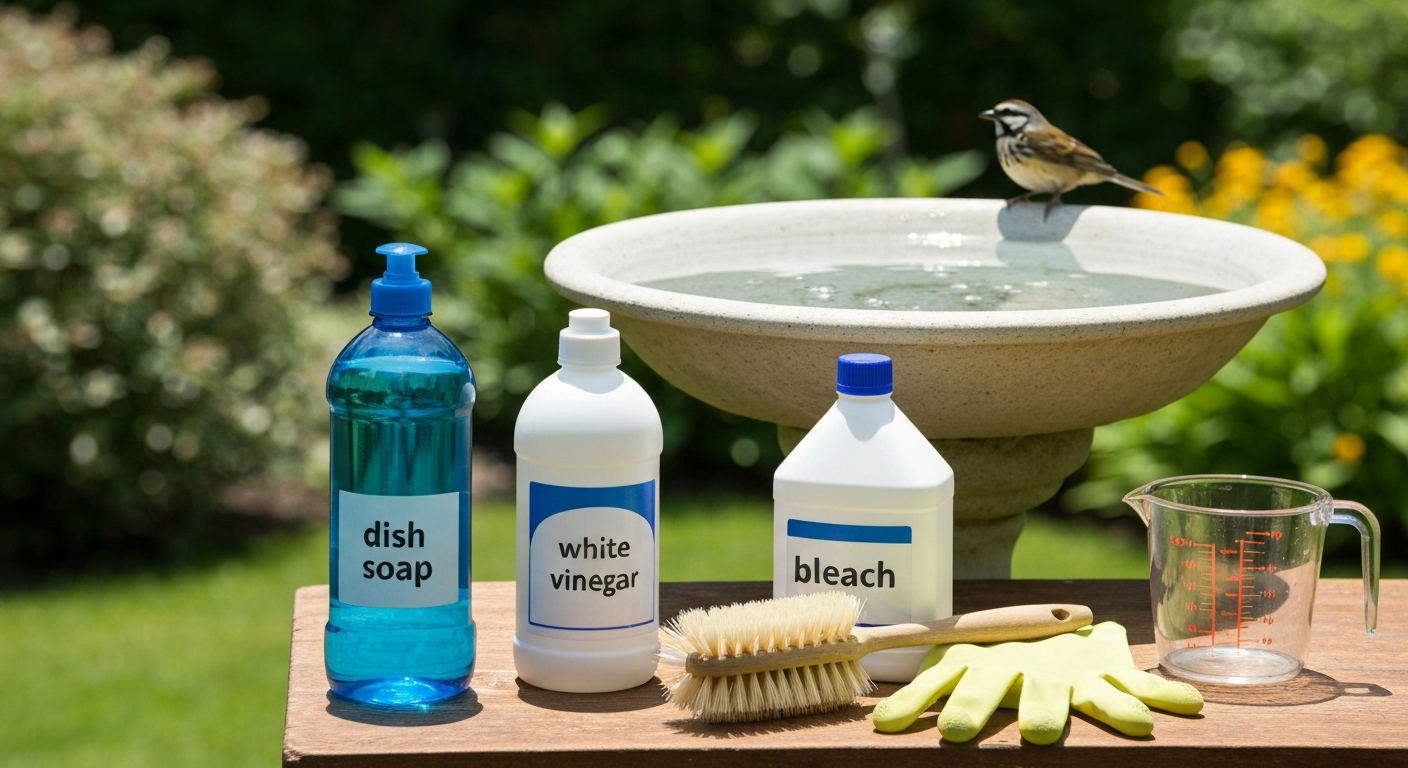
For most routine cleanings, diluted Dawn dish soap or white vinegar will do the job just fine. When you need to disinfect, after a sick bird visits, during a local disease outbreak, or when the basin gets truly foul, a freshly mixed 1:9 bleach-to-water solution (one part household bleach, nine parts water) is the gold standard recommended by USGS, the Cornell Lab, and Audubon. The key with any cleaner is thorough rinsing afterward, because residue is what actually harms birds, not the cleaner itself.
Best bird bath cleaner: Safe, Effective Picks & DIY Guide

Marcus Henley
27 Jul 2026
Why a clean bird bath matters more than you might think
Bird baths collect everything: feathers, droppings, algae, soil, dead insects, and the bacteria that come with all of it. Stagnant, dirty water spreads salmonellosis, avian pox, and trichomoniasis among birds that visit in quick succession. The RSPB recommends cleaning at minimum once a week in warm weather and replacing water daily during summer heat. If you can't maintain that schedule, it's genuinely better to remove the bath temporarily than to leave filthy water out. A clean bath doesn't just look nicer, it's a health measure for every bird that dips its beak in.
This guide covers everything you need to choose the right cleaner for your situation, mix it correctly, use it safely on any bath material, and rinse it off completely before the birds come back. I'll also hit on prevention strategies that reduce how often you need to scrub in the first place.
What actually makes a bird bath cleaner the "best"
There's no single perfect cleaner for every situation, but there are five criteria I use to judge any option before recommending it.
- Safety for birds: The cleaner must rinse away completely without leaving toxic residues. Birds drink from bird baths, and their respiratory systems are far more sensitive than ours — even fumes from concentrated bleach can harm nearby birds (per the Merck Veterinary Manual).
- Cleaning effectiveness: Can it cut through algae, droppings, biofilm, and organic buildup? A cleaner that looks like it works but leaves biofilm intact is a false economy.
- Material compatibility: Bleach can corrode metal. Vinegar can slowly etch calcium carbonate in concrete and unglazed stone. What's safe on glazed ceramic may not be safe on galvanized steel.
- Rinseability: How easily does it wash off? Detergents that strip feather oils are dangerous if they linger. Dawn rinses readily; thicker soaps and some commercial cleaners are stickier.
- Environmental impact: What goes down the drain or onto your lawn matters, especially if you're near a garden pond or vegetable bed. Dilute bleach breaks down quickly outdoors; concentrated pool chlorine does not.
Quick recommendations: which cleaner to use when
Here's how I think about it. Each cleaner has a sweet spot. Using the right one for the right job saves time and protects your birds.
| Cleaner | Best for | Limitations | Bird-safe after rinsing? |
|---|---|---|---|
| Dawn dish soap (2–3 drops per gallon) | Regular weekly scrubbing, oily residue, light organic soil | Strips feather oils if residue remains; not a disinfectant | Yes, with thorough rinsing |
| White vinegar (1:1 with water) | Mild algae, mineral deposits, light biofilm | Less microbicidal than bleach; can etch porous stone over time | Yes, rinses easily |
| Household bleach 1:9 dilution (10%) | Full disinfection, disease outbreak, heavy contamination | Corrosive to metal; fumes dangerous to birds; must be used fresh | Yes, after 2+ thorough rinses and full air-dry |
| Commercial bird-bath cleaners (enzyme or citric acid-based) | Easy-to-use routine maintenance without DIY mixing | Cost more; check labels for contact time and rinse instructions | Yes, if labeled bird-safe and rinsed per directions |
| Salt-free algaecides (barley straw extract, enzyme-based) | Prevention and slow algae growth between cleanings | Do not replace physical scrubbing; read labels carefully | Most yes, but verify label — avoid copper-based algaecides |
A quick note on chlorine: pool chlorine is not the same as diluted household bleach, and I'd steer clear of it entirely for bird baths. It comes in much higher concentrations and is far harder to rinse to a safe level. If you're curious about the broader question of adding chlorine to bird bath water, that's a separate discussion worth reading through before you experiment.
Safety rules, and things you should never do
I can't stress this enough: the cleaner is almost never the danger. The danger is residue, fumes near birds, and chemical combinations that create something far more hazardous than either ingredient alone.
- Never mix bleach with vinegar, any other acid, or ammonia-based cleaners. Mixing bleach and acid releases chlorine gas. Mixing bleach and ammonia produces chloramine gas. Both are toxic and can happen in seconds.
- Never use pool chlorine tablets or granular pool shock in a bird bath. Concentrations are far too high and residuals persist long after the water looks clear.
- Don't use bleach on copper or galvanized metal baths. It accelerates corrosion and can leach metals into the water.
- Keep birds away while you're cleaning. Move the bath out of sight if possible, or place it where birds can't land nearby until you've finished rinsing and the bath has dried.
- Work outside or in a well-ventilated space when using bleach. Avian respiratory systems are acutely sensitive to airborne chlorine fumes — this applies even to birds in a nearby cage, not just the ones visiting your yard.
- Wear rubber gloves with bleach. Nitrile or latex gloves for vinegar and dish soap work too if you have sensitive skin.
- Never leave concentrated bleach sitting in a metal bath. Even brief contact degrades galvanized coatings.
- Don't use detergents with added fragrances, antibacterials, or degreasers beyond standard Dawn or similar plain dish soap. Extra ingredients mean extra unknowns for bird safety.
Exact dilution ratios and DIY cleaner recipes
Precision matters here. Too weak and you're not actually cleaning. Too strong and rinsing becomes inadequate at normal volumes. These are the ratios I use, backed by USGS, Cornell Lab, and CDC guidance.
Dawn dish soap solution
Add 2 to 3 drops of plain Dawn (original blue formula) to one gallon of warm water. That's it. You want just enough to lift grease and organic soil without creating a sudsy mess that's hard to rinse. Use this for routine weekly cleaning on any bath material. For a focused discussion, see Can I use Dawn to clean a bird bath Can I use Dawn to clean a bird bath?. Contact time: scrub for 2 to 3 minutes and rinse immediately. You don't need to let it soak.
White vinegar cleaning mix
Mix one part household white vinegar (5% acetic acid) with one part water for a 2.5% working solution. This is useful for mineral deposits and mild algae. For guidance on whether you should use vinegar in your bird bath, see can you put vinegar in a bird bath. For stubborn buildup, you can use it undiluted at full 5% strength, but avoid that on porous stone or unglazed concrete where it can etch the surface with repeated use. Let it sit for 5 to 10 minutes before scrubbing. Rinse thoroughly, vinegar rinses easily and doesn't require the extended drying time that bleach does.
Household bleach disinfection solution (1:9)
Combine one part household bleach (standard 3–6% sodium hypochlorite) with nine parts water. Audubon likewise advises washing baths and feeders and, when disinfecting, using a freshly mixed 1:9 bleach-to-water solution, then rinsing thoroughly and allowing to air-dry (Three Easy but Important Ways to Keep Your Bird Feeders Disease‑Free, Audubon) blank" rel="noopener noreferrer">Three Easy but Important Ways to Keep Your Bird Feeders Disease‑Free — Audubon. For a small batch, that's roughly 1.5 tablespoons of bleach per cup of water, or about three-quarters of a cup of bleach per half-gallon. Mix it fresh each time, bleach degrades quickly in diluted form and a solution mixed yesterday may have lost significant disinfecting power. Allow this solution to contact all surfaces for at least 10 minutes (the contact time used in Cornell Lab and blank" rel="noopener noreferrer">EPA guidance for hard surface disinfection). Then rinse at least twice with clean water and allow the bath to fully air-dry before refilling.
Step-by-step cleaning procedure for any bird bath
This sequence works regardless of which cleaner you choose. I follow this every single time, and it takes about 15 minutes once you've done it a few times.
- Empty the bath completely. Tip it over or use a small cup to remove all standing water. Don't just top it up — old water sitting underneath fresh water still harbors bacteria.
- Remove loose debris by hand or with a stiff-bristled brush (dedicated to this task only). Knock out leaves, feathers, and visible droppings before applying any cleaner.
- Apply your chosen cleaner and scrub. Use a stiff nylon brush to work the cleaner into all surfaces, paying extra attention to textured areas, grooves, and the basin's lowest point where sediment collects. A retired toothbrush works well for decorative crevices.
- Soak if disinfecting. If you're using the bleach solution, let it sit on all surfaces for a full 10 minutes. For vinegar, 5 to 10 minutes. For dish soap, scrubbing time alone is sufficient.
- Rinse thoroughly. Pour at least two full basins of clean water through the bath, scrubbing the basin walls as you rinse. For bleach, do a third rinse. The goal is zero detectable smell of the cleaner.
- Check for residue. Run a clean wet finger along the basin floor. It should feel slightly rough or neutral — no slippery film, no chemical smell, no suds.
- Air-dry if you used bleach. Stand the bath on its edge or invert it for 15 to 30 minutes in fresh air. Sun helps neutralize any trace chlorine remaining.
- Refill with fresh water. Use the shallowest depth appropriate for the birds you're targeting — most songbirds prefer 1 to 2 inches.
Cleaning by material: what's safe and what to avoid
The material your bath is made from changes which cleaners are appropriate. I've made mistakes on this front, used vinegar on a beautiful concrete bath one too many times and ended up with surface pitting. Here's what I've learned, and what the manufacturer guidance backs up.
Concrete bird baths
Concrete is porous and alkaline. Dish soap and diluted bleach are both fine for concrete and are my go-to options. Be cautious with vinegar: acetic acid reacts chemically with the calcium carbonate in concrete and can slowly degrade the surface with repeated use. An occasional vinegar treatment won't ruin a bath, but weekly vinegar use will. Also note that new concrete can leach lime into the water, raising pH, cure a brand-new concrete bath by filling it with water and letting it sit for 48 to 72 hours, dumping it, and repeating twice before adding your cleaning step.
Unglazed and porous stone baths
These behave a lot like concrete. The porosity means biofilm can penetrate below the surface, so physical scrubbing with a stiff brush matters more here than with glazed materials. Diluted bleach works well and is my preferred disinfectant for stone. Avoid concentrated vinegar for the same reasons as concrete. Rinse extra carefully because porous materials hold cleaner longer in their micro-texture.
Glazed ceramic bird baths
Glazed ceramic is the easiest material to clean. The smooth, non-porous surface resists biofilm penetration and rinses completely. All three cleaners, dish soap, vinegar, and diluted bleach, are safe for glazed surfaces. Avoid abrasive scrubbers that can scratch the glaze and create micro-grooves where bacteria can hide. Stick to a soft to medium nylon brush.
Metal baths (stainless steel, cast iron, galvanized, copper)
Metal requires the most care. Stainless steel handles all three cleaners reasonably well, but even stainless can develop micro-pitting with repeated bleach use, keep bleach contact brief (10 minutes, not longer) and rinse promptly. Galvanized metal is the most problematic: bleach accelerates the breakdown of the zinc coating, which can then leach into the water. For galvanized baths, use dish soap for routine cleaning and skip bleach entirely. Copper baths are naturally antimicrobial, which is a real advantage, but bleach will corrode copper and should never be used on it. Vinegar will also slowly react with copper over time. Stick to plain dish soap for copper, and rinse extremely well.
Plastic and resin baths
Most plastic baths handle all three cleaners without chemical damage, but prolonged bleach soaking can cause some plastics to become brittle over time, keep the 10-minute contact time and don't let bleach solution sit for hours. Avoid abrasive brushes on smooth plastic because scratches create hiding places for bacteria. Plastic tends to develop a stubborn green-gray biofilm; a slightly stronger vinegar solution (undiluted 5% vinegar) works well for this before your final rinse or bleach disinfection step.
Painted surfaces and decorative finishes
Bleach can fade or lift paint, especially exterior latex or acrylic finishes on decorative baths. If your bath has a painted surface you want to preserve, stick to dish soap for routine cleaning. If you need to disinfect, use diluted bleach sparingly, keep contact time short (5 minutes rather than 10), and rinse immediately. Accept that frequent bleach use will eventually affect the finish.
Rinsing and drying: how to know when the bath is safe
Rinsing is where a lot of people cut corners, and that's where birds get hurt. Detergents strip feather waterproofing and insulation, International Bird Rescue uses Dawn in oiled-bird rehabilitation precisely because it's effective, but their protocol involves exhaustive rinsing with large water volumes and careful monitoring until the bird's feather structure recovers. For a bird bath, the stakes are lower than a coated pelican, but the principle is the same: zero residue.
| Cleaner used | Minimum rinses | Air-dry required? | Safe-to-refill test |
|---|---|---|---|
| Dawn dish soap | 2 full basin flushes | No, but recommended | No suds, no slippery film, no smell |
| White vinegar (1:1) | 2 full basin flushes | No | No vinegar smell, no film |
| Household bleach (1:9) | 3 full basin flushes | Yes — 15 to 30 min in fresh air | No chlorine smell after drying; finger test shows no residue |
| Commercial bird-bath cleaner | Per product label | Per product label | Follow label; treat like dish soap if enzyme-based |
The nose test is your most reliable tool: if you can still smell chlorine after the bath has air-dried for 15 to 30 minutes, rinse again. Trace chlorine in drinking water has been studied in poultry at relatively low concentrations without acute effects, but wild birds are more variable in size, species, and health status, I wouldn't rely on that margin of safety when a few extra minutes of rinsing costs nothing. If you want to chemically neutralize any remaining chlorine, sodium thiosulfate (sold as a dechlorinator for aquariums and ponds) will do it instantly, but for a well-rinsed bird bath it's rarely necessary.
How often should you be cleaning?
The honest answer is more often than most people do. In summer heat, algae can establish itself within 24 to 48 hours in a sunny bath. Here's a schedule that balances thoroughness with real-world time constraints.
| Task | Frequency (hot weather) | Frequency (cool/cold weather) |
|---|---|---|
| Refill with fresh water | Daily | Every 2 to 3 days (or when frozen) |
| Quick rinse and brush-out | Every 2 to 3 days | Weekly |
| Full soap-and-scrub cleaning | Weekly | Every 2 weeks |
| Disinfection with bleach solution | Monthly, or after any disease concern | Every 4 to 6 weeks |
Preventing buildup so you clean less often
The best cleaning schedule is the one you actually keep, which means reducing the workload. Several factors dramatically slow algae and biofilm growth.
- Shade the bath during peak sun hours. Algae needs light. Moving a bath to morning sun and afternoon shade can cut algae growth dramatically. Keeping water cool also makes the bath more attractive to birds during summer heat.
- Add a dripper, fountain, or solar agitator. Moving water discourages algae, resists mosquito breeding (female mosquitoes need still water to lay eggs), and attracts more birds with the sound. Even a small solar-powered fountain pump costing under $20 makes a visible difference.
- Use a salt-free, copper-free enzyme-based algaecide. Products based on barley straw extract or enzyme formulations slow algae growth between cleanings. Avoid copper-based algaecides — copper ions accumulate in water and can be harmful to birds and other wildlife.
- Keep the bath in a spot that's easy to access. This sounds obvious, but if the bath is awkward to reach, you won't clean it on schedule. Convenience matters.
- Use a basin with a smooth surface. Textured baths look beautiful but harbor biofilm more readily. If you can, choose a smooth-bottomed basin for your primary bath and save the decorative textured ones for display.
Troubleshooting: algae, mosquitoes, and water quality
Persistent green algae
If you're scrubbing algae weekly and it's back in two days, the problem is usually sun exposure combined with warm water. Learn more about how to keep bird bath water cool. Shade is your first line of defense. For the cleaning itself, the bleach disinfection step actually kills algae spores that soap and vinegar leave behind, so a monthly bleach treatment in summer will reset the growth cycle more effectively than frequent soap scrubbing alone.
Mosquito larvae
If you see small wriggling larvae in the bath, change the water immediately and add a dripper or agitator. Mosquitoes require still water for breeding, so even a slow drip breaks the cycle. Dunks (Bacillus thuringiensis israelensis, or Bti) are widely used and labeled as safe for birds and other wildlife, though I'd still dump and clean the bath first rather than relying on them as the only solution.
Water quality and tap water
Tap water is safe for bird baths in most municipalities and is what the vast majority of backyard birders use. The residual chlorine in tap water at normal municipal treatment levels is not a concern at bird bath volumes, it dissipates quickly in an outdoor container, often within a few hours of sitting in the open air. If you're using well water with high mineral content, you may see more calcium scaling, which vinegar handles well.
Seasonal notes: cleaning in winter
If you run a heated bird bath in winter, cleaning frequency doesn't drop as much as you'd hope, warm water still grows biofilm, just a bit more slowly. The main challenge is that cold-weather cleaning with bleach or water is miserable when your fingers are numb. I default to plain dish soap and a stiff brush through winter, and do a full bleach disinfection in late fall before the really cold weeks hit, then again in early spring when bird activity picks back up. If your bath freezes and thaws repeatedly, check for cracks (especially in concrete and ceramic) before continuing to use it, freeze-thaw cycles can open hairline fractures that trap biofilm below the surface where brushes can't reach.
FAQ
What is the single safest and most effective disinfectant for bird baths when disease control is needed?
For routine disinfection during disease‑prevention events or when baths are heavily soiled, a freshly prepared 1:9 household bleach:water solution (one part common household bleach to nine parts water, often called a 10% bleach solution) is the most broadly effective option recommended by wildlife and public‑health authorities. Soak cleaned surfaces for about 10 minutes, then rinse thoroughly and let air‑dry. Prepare the solution fresh and follow bleach safety precautions (ventilate, avoid mixing with acids/ammonia, use gloves/eye protection).
When is milder cleaning (not bleach) acceptable, and which cleaners are best for routine maintenance?
Daily or weekly maintenance can usually be done with warm water and a mild dish detergent (a few drops of Dawn‑style dish soap) or plain distilled white vinegar (5% acetic acid) for light biofilm/algae. Use soap for greasy/organic build‑up; use vinegar as a mild, non‑chlorine cleaner when you prefer to avoid bleach. Both require thorough rinsing and complete drying before refilling for birds. Reserve bleach for suspected disease outbreaks or persistent contamination.
Exactly how do I clean and disinfect a bird bath step‑by‑step (general method)?
1) Empty and scrape out loose debris. 2) Wash with warm water and a soft brush plus mild dish soap (or vinegar) to remove organic film. 3) Rinse. 4) If disinfecting, immerse or apply a fresh 1:9 bleach:water solution so all wet surfaces remain in contact for ~10 minutes. 5) Rinse thoroughly with clean water until bleach odor is gone. 6) Air‑dry completely before refilling. For vertical or fixed baths, drain, scrub, apply bleach solution with a spray/pour, wait 10 minutes, then flush/rinse repeatedly.
What dilution ratios and contact times should I use for each cleaning agent?
- Household bleach (sodium hypochlorite): mix 1 part bleach to 9 parts water (10%) and contact for ~10 minutes for disinfection. - Dawn‑style dish soap: a few drops in a sink of warm water (no formal disinfectant contact time; use for cleaning only), scrub, then rinse. - Household white vinegar (≈5% acetic acid): use full‑strength or diluted 1:1 with water for cleaning/algae removal; allow several minutes of contact and scrub—vinegar is a milder microbicide and not as reliably broad‑spectrum as bleach. Always rinse and dry after cleaning.
Are there material‑specific cautions or different procedures for concrete, ceramic, metal, plastic and glazed baths?
- Concrete: porous; soaks up contaminants and cleaners. Scrub with detergent, then disinfect with 1:9 bleach solution; rinse extra thoroughly and allow extended drying. Avoid prolonged exposure to undiluted vinegar (can etch over time). - Glazed ceramic: nonporous; safe with soap, vinegar or dilute bleach. Avoid hammering or abrasive tools that chip glaze. Rinse well after bleach. - Metal (galvanized, copper, stainless): stainless is generally safe with bleach; avoid prolonged bleach contact on bare steel or non‑stainless metals as it can corrode. Copper/brass may discolor with bleach or vinegar—use mild soap and thorough rinsing. - Plastic/resin: avoid very hot water on thin plastics; bleach is acceptable but may cause fading over time—rinse thoroughly. - Stone/terra‑cotta: often porous and may be etched by vinegar; prefer soap and dilute bleach for disinfection, rinse and dry fully. When in doubt, consult the manufacturer’s care instructions.
How should I rinse and dry a bath after using bleach (or soap) so it’s safe for birds?
Rinse repeatedly with fresh water until no bleach odor remains. Use several water changes or a hose flush. Allow the bath to air‑dry completely in sunlight if possible; evaporation reduces residual chemicals. Avoid refilling and returning birds until the surface is odorless and dry. For fixed baths that cannot be dried easily, extended flushing and several minutes of airing and additional rinses are recommended.