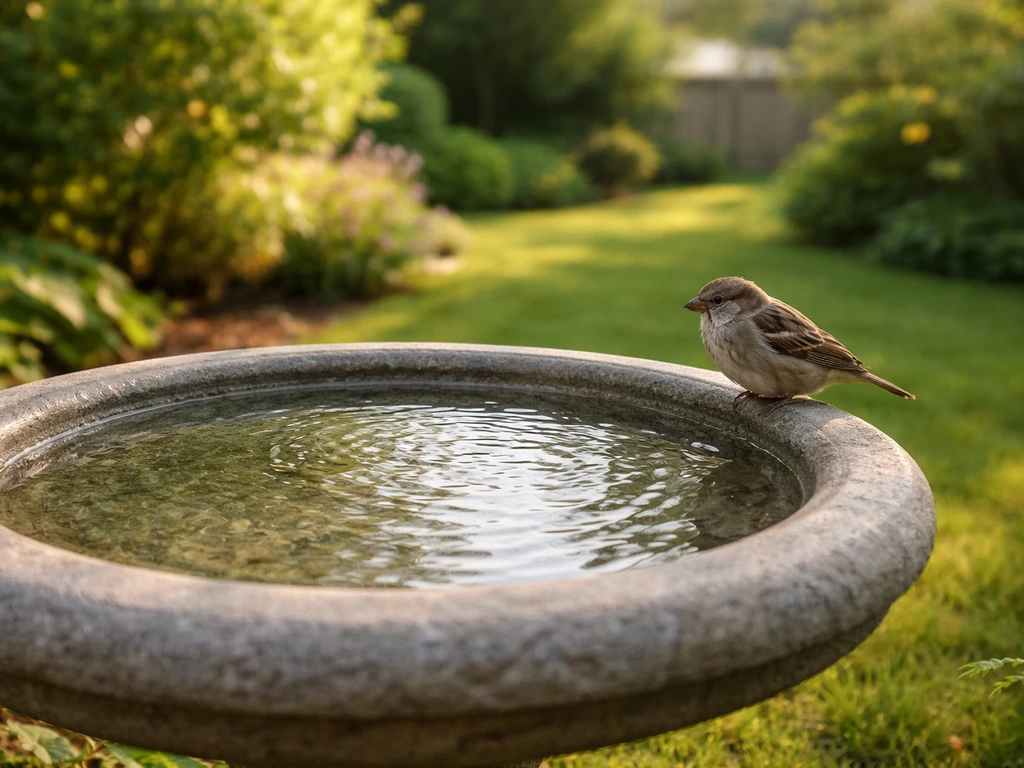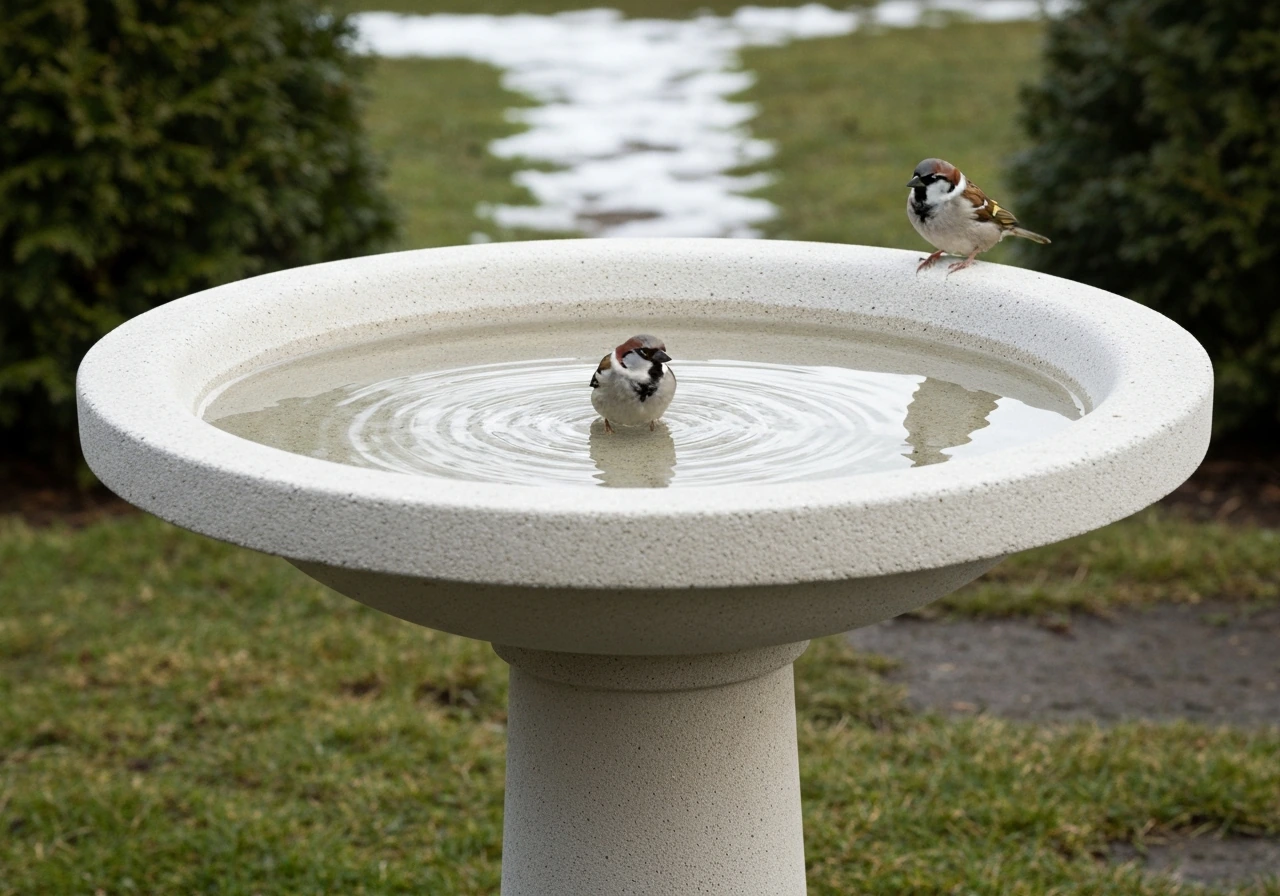
The best place to put a bird bath is in a partially open area of your yard, roughly 10 to 15 feet from shrubs or trees that give birds a quick escape route, out of reach of dense low cover where cats can hide, on level ground, and somewhere you can actually see it from a window. That combination covers safety, visibility, and ease of maintenance in one shot. Everything else is fine-tuning based on your specific yard layout, your local climate, and the birds you want to attract.
Where to Put a Bird Bath: Best Placement Guide

Marcus Henley
15 Apr 2026
Best bird bath placement basics
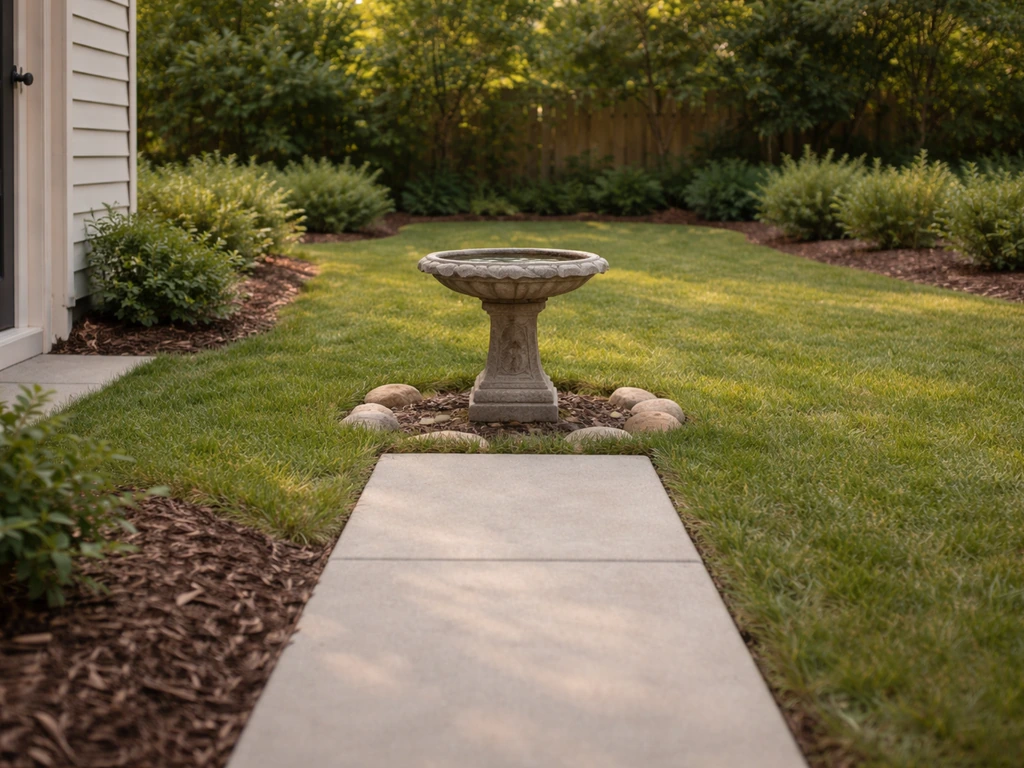
Start with two non-negotiables: birds need to feel safe approaching the water, and you need to be able to reach it easily for cleaning. The National Audubon Society recommends refilling bird bath water every other day, so if getting to the bath is a hassle, it won't get done. Pick a spot with a clear path from your hose or water source. Then think about sight lines. The RSPB specifically advises putting a bird bath where birds will be safe and where you can watch the activity from inside your home. That second part matters more than people realize. If you can't see the bath, you won't notice when it's empty, algae-covered, or being monopolized by one aggressive species.
Keep it away from your feeders. Bob Vila recommends maintaining at least 10 to 15 feet of distance between feeders and a bird bath. Seeds, hulls, and droppings from feeders fall into the water and accelerate bacterial growth. That separation makes both the feeder area and the bath easier to manage individually.
How to choose the right spot in your yard or garden
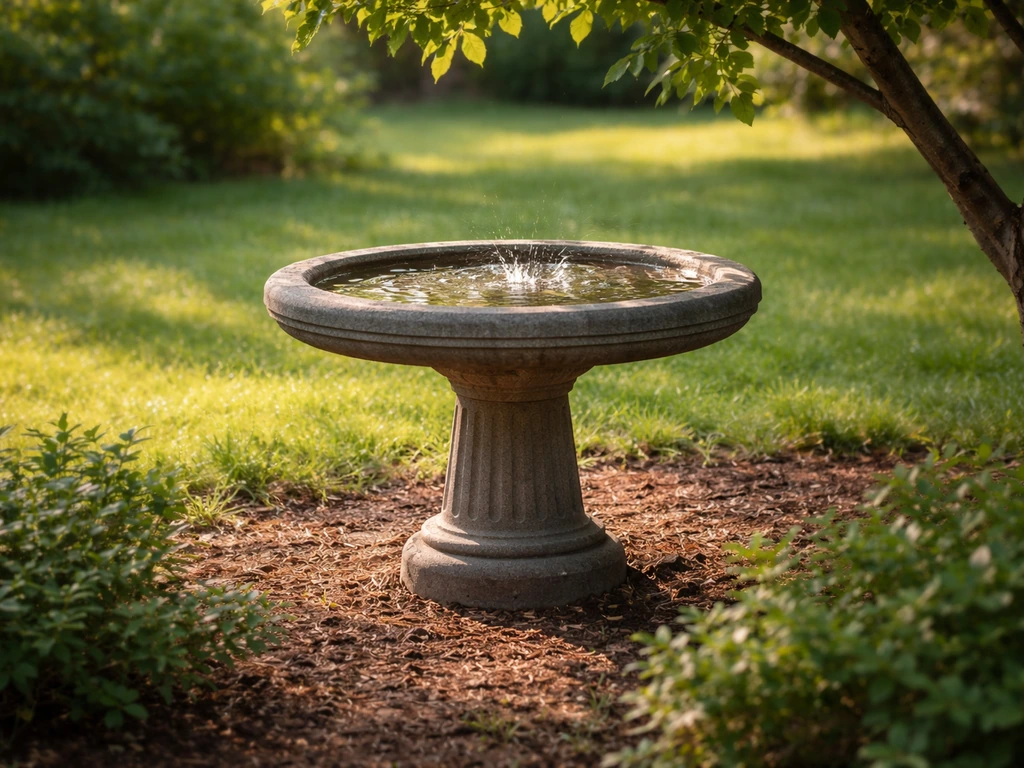
The ideal yard location balances open space with nearby escape cover. Connecticut DEEP puts it clearly: place the bath where there is natural shelter nearby in case predators approach, but not so close that cats can ambush unsuspecting birds. In practice, that means setting the bath in an open patch of lawn or garden bed, with a shrub, hedge, or small tree within about 20 feet. Audubon Rhode Island uses that 20-foot figure specifically, noting birds need to escape quickly to the safety of a tree or shrub. Close enough to reach fast, far enough that a crouching cat can't launch from it.
Avoid putting the bath right against a fence line, dense foundation planting, or under low-hanging branches. Gardening Know How recommends a safety zone of about 6 to 10 feet of clear space around the bath so birds have a vantage point and room to react. Some older guidelines suggest at least 6 feet from any cover, but 10 feet is more comfortable if your yard allows it. One helpful layout approach comes from Audubon Community Nature Center, which describes a setup where the bath sits in line with feeders and is backed by large shrubs or trees. The vegetation gives birds a place to perch and scope things out before committing to a bath.
If you're also thinking about the surrounding garden design, the plants you choose nearby matter a lot. Knowing what to plant around a bird bath can help you create the right balance of shelter and open sightlines without accidentally giving predators a hiding spot.
Sun, shade, and temperature considerations
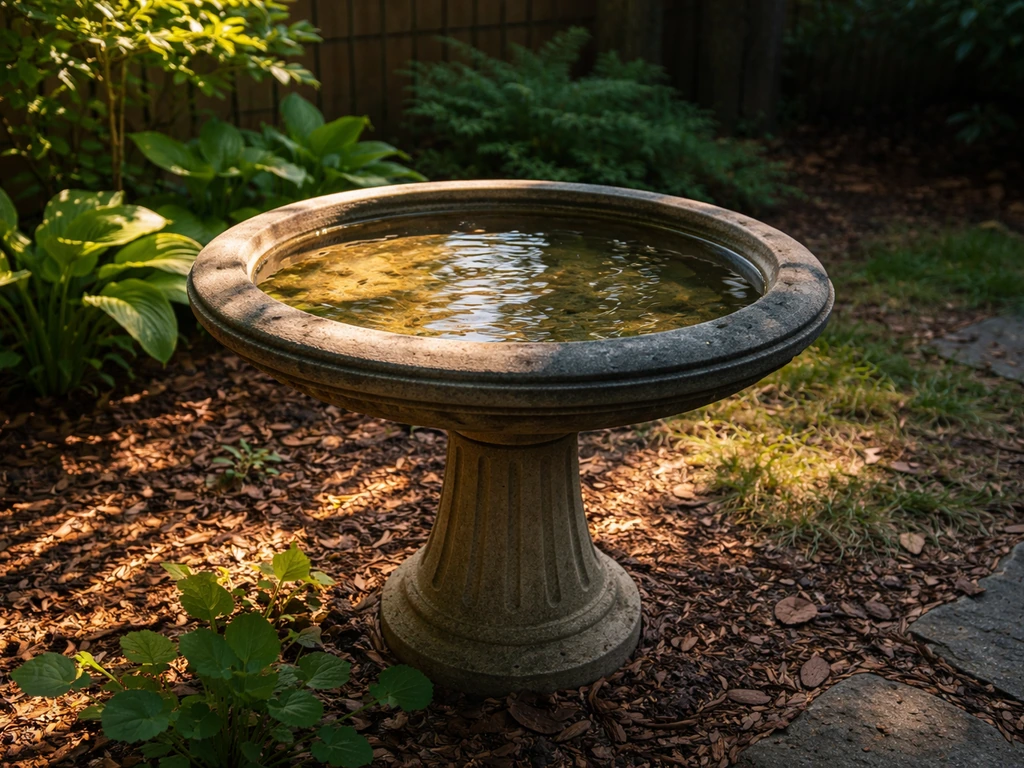
Partial shade is the sweet spot for most climates. Full sun heats the water quickly, accelerates algae growth, and evaporates water faster. Full shade stays cooler but limits how long you can see bird activity and can slow evaporation to the point where the water gets stagnant. Aosom's placement guidance recommends partially shaded open areas as a general rule, and Audubon echoes this, advising placement in a shady area with surrounding vegetation.
In summer, morning sun and afternoon shade is the best arrangement in most of the US. It keeps water from getting hot mid-day and slows the green-water problem. In winter, the math flips completely. You want the sunniest spot available to help slow freezing and help thaw ice earlier in the day. Backyard Nature specifically recommends moving the bath to the sunniest part of your yard in cold months to take advantage of solar warming.
If you're in a region where temperatures drop below freezing regularly, your placement also needs to account for a power source. Farmers' Almanac recommends using an outdoor-rated immersion heater to keep the water liquid. That means your winter bird bath location should be close enough to an outdoor GFCI outlet to run a cord safely. Do not use extension cords through snow or puddles, and follow the heater manufacturer's directions exactly. Kasco's de-icer guidance, for example, explicitly warns that operating a de-icer dry (out of water) can be hazardous. Plan the cord run before you commit to a winter spot. And resist the temptation to pour boiling water on ice or chip at a frozen bath. Farmers' Almanac flags both as ways to crack or damage the basin.
If you have a concrete bath and live somewhere with hard freezes, National Geographic notes that concrete is especially vulnerable to cracking when wet and frozen, so you may need to drain and store it rather than leave it out all winter. That's a placement and seasonal planning consideration, not just a material one.
Safety, access, and predator avoidance
Predator risk shapes placement more than most people expect. Cats are the biggest concern in most residential yards, but hawks also matter. The general principle from the U.S. Fish and Wildlife Service and multiple state wildlife agencies is the same: give birds a clear view of their surroundings while bathing, and give them a fast escape route. That means no placement right next to a fence where a cat can crouch and spring, and no placement under a tree limb where a hawk can drop straight down.
The 6-to-10-foot clear zone around the bath is the practical standard most sources agree on. PlantAnswers recommends at least 6 feet from cover specifically to prevent predator ambush. The Natural History Museum likewise recommends an open area of the garden as the starting point. Both land in the same place: open enough to see threats, close enough to cover to flee.
On the maintenance side, easy access protects bird health too. National Geographic emphasizes keeping the bath clean to help prevent disease spread among wild birds. A bath you can walk up to comfortably, tip to drain, and scrub without moving furniture around will actually get cleaned on schedule. Place it on a firm, stable surface rather than soft ground where it can sink or tilt over time.
Height, distance, and water depth positioning
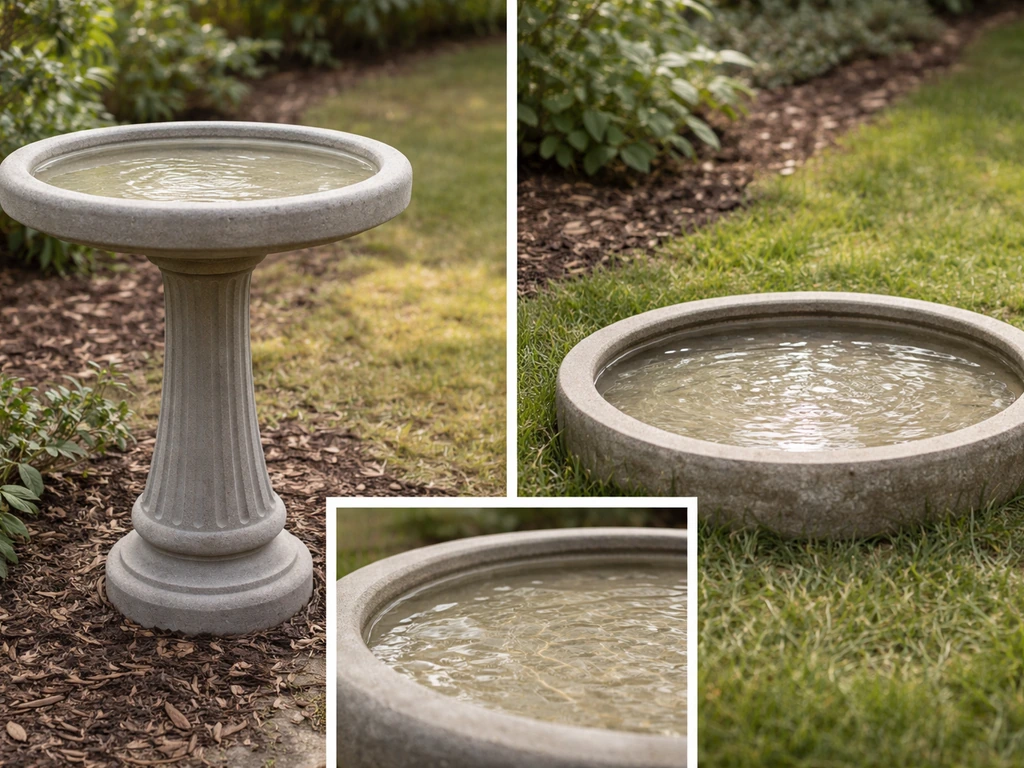
Standard pedestal bird baths sit about 24 to 36 inches off the ground. That height works well for most songbirds and gives cats a harder approach. Ground-level baths attract a wider variety of species (including larger birds like crows and doves) but require more vigilance about predator cover nearby. If you go with a ground bath, the open-zone clearance matters even more.
Water depth is something a lot of people get wrong. The Washington Department of Fish and Wildlife recommends shallow water, typically one to three inches at the deepest point, with edges that slope gradually for comfortable wading. Audubon's practical target is about one inch to one-and-a-half inches deep. The RSPB caps it at around 10 centimeters (roughly 4 inches) maximum, with wide, shallow, sloping sides. The NWF puts the small-bird comfort limit at no more than about three inches. If your basin is too deep, birds won't use it or they'll only drink from the edge.
If you have a deeper basin, add a rock or two to create shallow-water islands where small birds can stand and bathe safely. The NWF specifically suggests this rock trick as a practical fix. The RSPB emphasizes that sloping sides build birds' confidence to actually enter the water, rather than just drinking from the rim.
Placement for specific birds
Hummingbirds
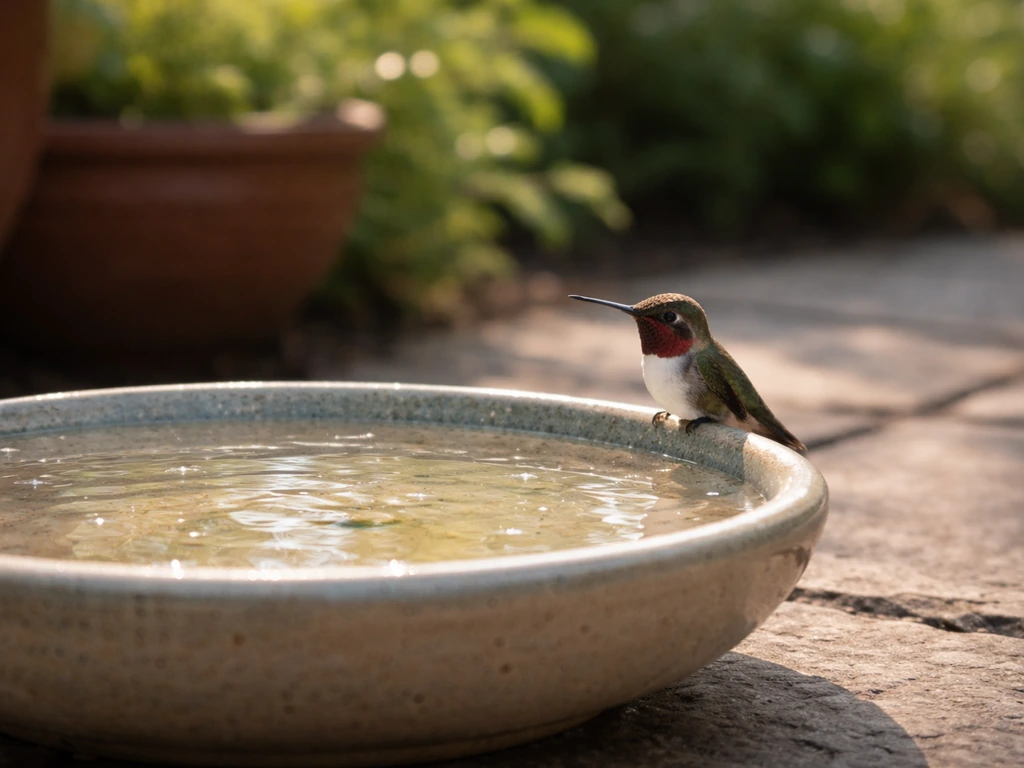
Hummingbirds are not typical bird bath users. They prefer extremely shallow water, about half an inch or less according to a Los Angeles Times Q&A on hummingbird bathing behavior, and they're more comfortable with moving water or fine mist than still water in a basin. Virginia Tech Extension notes that hummingbirds may use dew and suggests a fine spray mister as an effective way to meet their water needs. If you want hummingbirds specifically, place a small mister or drip attachment on an existing bath, or set up a dedicated shallow dish mister near flowering plants they already visit. Position it where the spray catches the light, which also helps you spot hummingbirds from a window.
Crows and larger birds
Crows are smart, cautious, and surprisingly regular bird bath visitors. Connecticut DEEP notes that American crows will use bird bath water to soften food they've found. To attract crows, a lower bath works better than a high pedestal because crows are large birds and can be awkward on small elevated basins. Place a wider, ground-level or low-set bath in a fairly open area, ideally with a tall tree nearby since crows prefer to observe from height before descending. Don't expect crows and small songbirds to share comfortably. If crow traffic is heavy, smaller birds may avoid the bath when crows are present.
General songbirds
Most backyard songbirds respond well to the standard placement formula: pedestal height, partial shade, near but not adjacent to shrub cover, within sight of feeders but not directly under them. Adding a drip or wiggler creates water movement that attracts birds from a distance. Position the bath where splashing won't hit a path or create a slipping hazard.
Comparing common placement scenarios
| Placement Scenario | Pros | Cons | Best For |
|---|---|---|---|
| Open lawn, pedestal height, partial shade | Maximum bird safety, good visibility, easy cleaning access | May need added cover nearby for smaller birds | Most songbirds, general backyard use |
| Near shrub border, 10 ft clearance | Natural escape cover, attractive setting | Risk of predator ambush if clearance shrinks | Warblers, sparrows, thrushes |
| Ground level, open area | Attracts wider variety including larger birds | Higher predator risk, needs more frequent cleaning | Crows, doves, robins |
| Shaded corner, near fence | Stays cool in summer | Poor sight lines, ambush risk, harder to monitor | Not recommended for most yards |
| Full sun, center of yard | Easy to monitor, no predator cover issues | Water heats fast, algae accelerates, evaporates quickly | Only if you can clean every 1 to 2 days |
Setup details: leveling, drainage, and sightlines
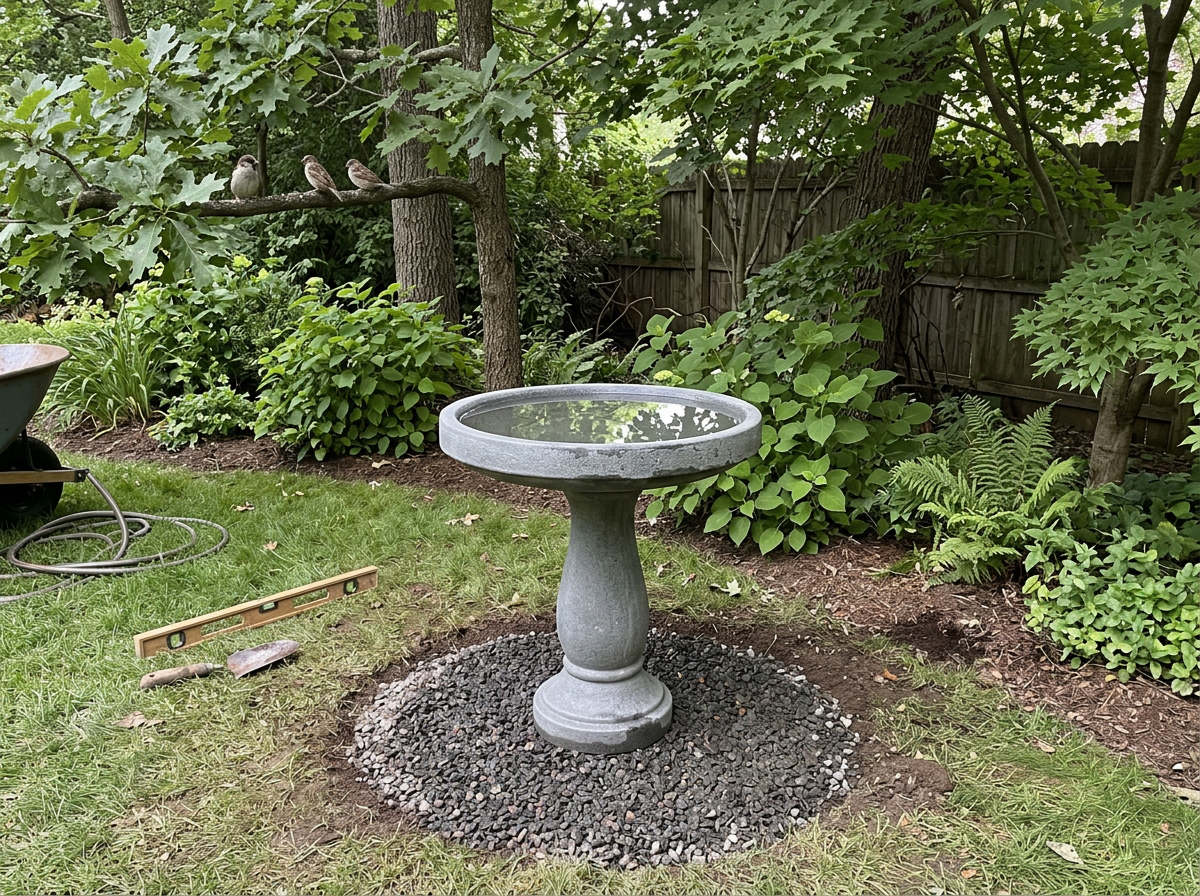
Level ground is non-negotiable. A tilted bath loses water on one side, birds avoid the shallow end, and a pedestal on uneven ground can tip. Before setting up, check the surface with a small bubble level. If you're placing the bath on lawn, tamp the grass down firmly or cut a small flat area. On a patio, check that the surface is actually level rather than pitched for drainage (many patios slope slightly toward the yard). Use a flat paver or stepping stone under the pedestal base if needed.
Drainage around the bath matters too. The splash zone gets wet, and standing water near the base can encourage mosquitoes or create muddy patches that make the area uninviting. Placing the bath on gravel, coarse sand, or a paved surface with natural drainage handles this cleanly. Aosom's placement guidance specifically calls out level ground and drainage access as part of the placement checklist.
Sightlines work both ways: you want to see the bath from a comfortable window, and birds want to see approaching threats from the bath. Orient the bath so the open approach direction faces a window or sitting area where you spend time. Birds will naturally orient themselves to face the open yard while bathing, which also means they'll be facing your view. A little thought here pays off every time you sit with a cup of coffee and watch the yard.
If you're building or assembling the bath yourself, like a stacked flower pot design, getting the base stable from the start prevents a lot of problems later. A flower pot bird bath is one of the easiest DIY options and can be placed almost anywhere using the same leveling and sightline principles above.
Making the surrounding landscape work for you
The plants and hardscape around your bird bath either help or hurt its effectiveness. The right nearby planting gives birds perches, cover, and food sources that keep them returning. The wrong planting creates predator hiding spots or drops debris into the water constantly. Thinking about how to landscape around a bird bath as part of your initial placement decision will save you from repositioning things later.
Some bird bath basins that aren't actively used for bathing make excellent shallow planters, which can be a creative way to repurpose an old or cracked bath. If you're curious about that angle, there's a lot of overlap between placement and planting. For instance, how to plant flowers in a bird bath covers converting basins into planters while keeping them decorative in your yard layout. You can even go low-water with the right species. Planting succulents in a bird bath is a surprisingly practical option for a second basin that adds visual interest near your main water feature.
If you want to use a basin that doesn't hold much water depth, it's worth knowing what flowers work well in a shallow bird bath if you're going the planter route, since shallow basins need plants matched to their limited soil depth. For a fuller picture of companion planting near a functional bath, choosing plants to grow around your bird bath covers which species provide cover and perches without creating predator cover or clogging the water.
The placement checklist before you set it down
- Choose a partially shaded spot: morning sun and afternoon shade is ideal in warm climates, full sun in cold climates or winter.
- Keep at least 6 to 10 feet of open space around the bath in all directions to prevent predator ambush.
- Place escape cover (shrubs or trees) within about 20 feet but not immediately adjacent to the bath.
- Stay 10 to 15 feet away from bird feeders to prevent debris contamination.
- Confirm the ground is level, and use a paver or stepping stone base if needed.
- Make sure a water source and, if needed, a GFCI outlet are within practical reach.
- Orient the bath so the open approach faces a window you use regularly.
- Set water depth to 1 to 1.5 inches for most songbirds; add rocks if your basin is deeper.
- Plan for drainage around the base so splash doesn't create muddy or standing-water problems.
- Walk the path from your house to the bath and confirm you can reach it easily for twice-weekly cleaning.
FAQ
Can I put a bird bath right next to a feeder if I keep it clean?
Try to avoid it. Even with frequent cleaning, feeder fallout (seed hulls and droppings) tends to accumulate in the bath and speeds algae and bacteria. If you must place them close for space, use a dedicated small “side feeder” area and position the bath so the wind-blown debris path does not fall into the basin.
How often should I change the water if I’m already refilling every couple of days?
Refill on the schedule you can reliably maintain, but do a full drain-and-scrub when you see scum, cloudiness, or slime starting around the edges. In warm weather, spot-clean daily by removing floating debris so you are not relying on dilution alone.
What if the only place I can see from my window is also heavily shaded?
Partial shade is ideal, but if you have deep shade most of the day, lean toward more frequent water swaps and shallower depth to reduce stagnation. You may also need a more visible splash pattern (drip or gentle wiggler) so birds still notice the water.
Is a bird bath safe for birds if it is near a wall or fence?
It can be risky if the fence or wall provides ambush angles for cats. If the bath must be near a boundary, create at least a 6 to 10 foot open zone on the approach side (the side birds face while bathing), and keep any dense hiding spots farther away than that clear zone.
How close should shrubs or small trees be for birds to escape quickly, but still prevent predator ambush?
Aim for nearby escape cover that is close enough for quick fleeing, without creating a crouch-and-spring setup. In practice, that often means cover within roughly 20 feet, while keeping a clear open space around the bath of about 6 to 10 feet so birds have room to enter and exit safely.
Do I need a pedestal height, or can I use a ground-level bath year-round?
You can use ground-level year-round, but you must be more deliberate about predator cover and your “open zone” clearance. Pedestal baths are generally more difficult for cats to approach from low positions, but ground baths can attract more species if the surrounding area stays open and you monitor cat activity.
What water depth should I choose if my basin is deeper than 1 to 3 inches?
Reduce usable depth with a few large, stable rocks to form shallow “islands” where small birds can stand. Make sure the rocks do not wobble, and keep the edges sloped so birds can wade in without stepping onto a deep bottom.
Will a bird bath attract mosquitoes if the ground around it stays wet?
It can, especially if splashing creates puddles or the base sits in soggy soil. Place the bath on gravel or a paved section with drainage, and empty any standing water around the pedestal area. Also consider setting the bath slightly away from low spots where water naturally collects.
How do I position the bath so both birds and people can see it?
Orient the basin so the open approach direction faces the viewing area you actually use, like a porch chair or favorite window. Birds tend to choose the direction with the safest-looking view, so turning the bath to align your sightline with their likely approach makes monitoring easier.
Can I use a bird bath in winter if I do not have outdoor electrical power nearby?
If you cannot run an outdoor-rated heater safely, you may need a non-electrical approach. Options include relocating the bath to a sunniest accessible spot and checking ice frequently, but you should avoid chipping or pouring boiling water on a frozen basin because it can crack or damage the surface.
What is the safest way to prevent ice without damaging the bath?
Use an outdoor-rated immersion heater or de-icer designed for bird safety and follow the manufacturer’s directions. Avoid harsh methods like pouring boiling water or aggressive chipping, and never run a de-icer dry (out of water), since that can be hazardous and can ruin the unit.
Do hummingbirds really use bird baths, and how should I place water for them?
Hummingbirds often prefer very shallow water or fine mist. If you want them, place a small mister or drip attachment where the spray is visible from a window, and keep the water container shallow enough that they can comfortably feed without needing to wade.
How do I place a bath to attract crows without scaring off small songbirds?
Use a lower, wider or ground-level setup in a fairly open area, but do not expect them to share comfortably. If crow traffic is heavy, keep smaller songbirds away from the same exact spot by using a separate bath or by placing the main bath farther from feeder activity.
My patio is slightly sloped. Is it still okay to place the bird bath there?
Use only a truly level placement. Even a slight pitch can cause water to pool on one side and leave the shallow edge unusable for wading birds. Check with a small bubble level and, if needed, add a flat paver or stepping stone under the pedestal base to correct the angle.
What should I do if birds ignore the bath after I install it?
Start by confirming shallow, sloped entry (not overly deep water) and changing the water so it is clean and fresh. Adding a drip or gentle moving-water setup can also help birds notice from a distance, and positioning in partial shade can reduce algae that makes the water unattractive.